

The Tiny Gravity Test Was Not Completely Random
There is a very specific silence that happens before a cat pushes something off a table.
The paw appears slowly. The object is perfectly still. The cat looks at it, then at you, then back at the object, as if the household has entered an important scientific phase. One tiny tap later, gravity has been tested, the floor has received new information, and the cat looks strangely satisfied with the result.
It is easy to call this behaviour naughty, dramatic, or personally targeted. Sometimes it definitely feels personal. But underneath the comedy, there is usually a mix of normal cat logic: curiosity, movement, attention, boredom, hunting-style play, and the very serious business of understanding what objects do.
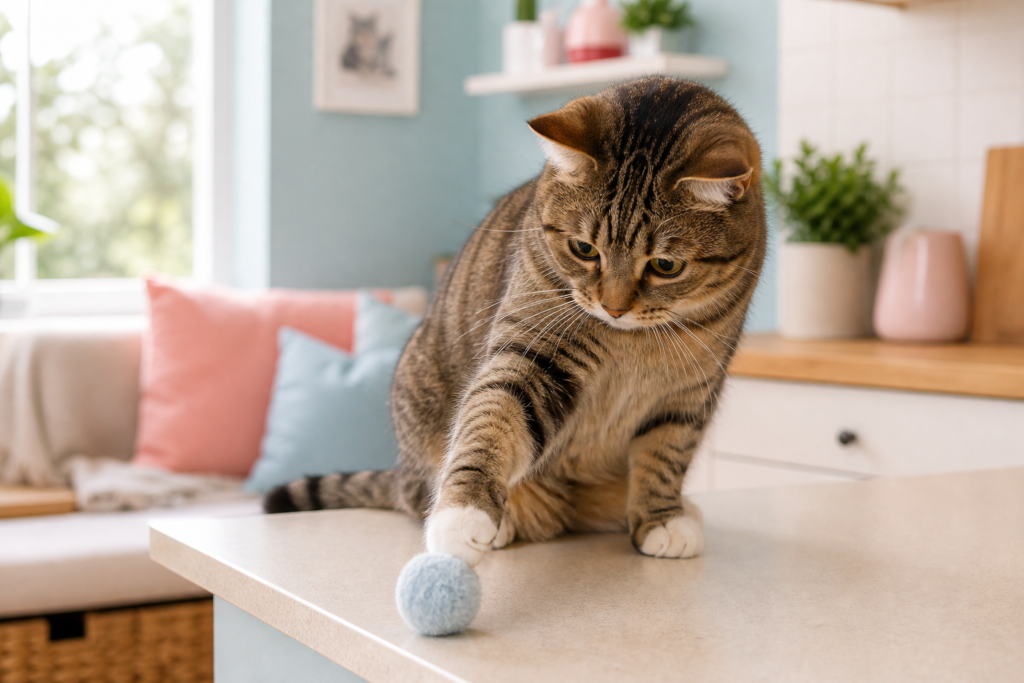
Cats do not see tables the way humans do. We see a place for keys, cups, remotes, plants, notebooks, decorations, and little things we are absolutely sure will stay there. A cat sees height, edges, textures, interesting shapes, scent, movement potential, and a perfect testing platform.
The result is one of the most recognisable cat moments in the world: the tiny gravity department opening another case.
The Table Is a Tiny Stage
Tables, shelves, counters, desks, bedside cabinets, and windowsills are not neutral spaces to cats. They are raised surfaces with good views, clear boundaries, and objects that can be inspected from multiple angles.
That matters because cats are highly environment-aware animals. The AAFP and ISFM feline environmental needs guidelines describe how important choice, safe spaces, and control can be for cats living indoors. A raised surface gives a cat a bit of that control. From there, it can watch the room, monitor movement, and decide what deserves further inspection.
Sometimes the thing being inspected is your pen.
Sometimes it is a lip balm.
Sometimes it is a small soft toy that has been promoted to “evidence.”
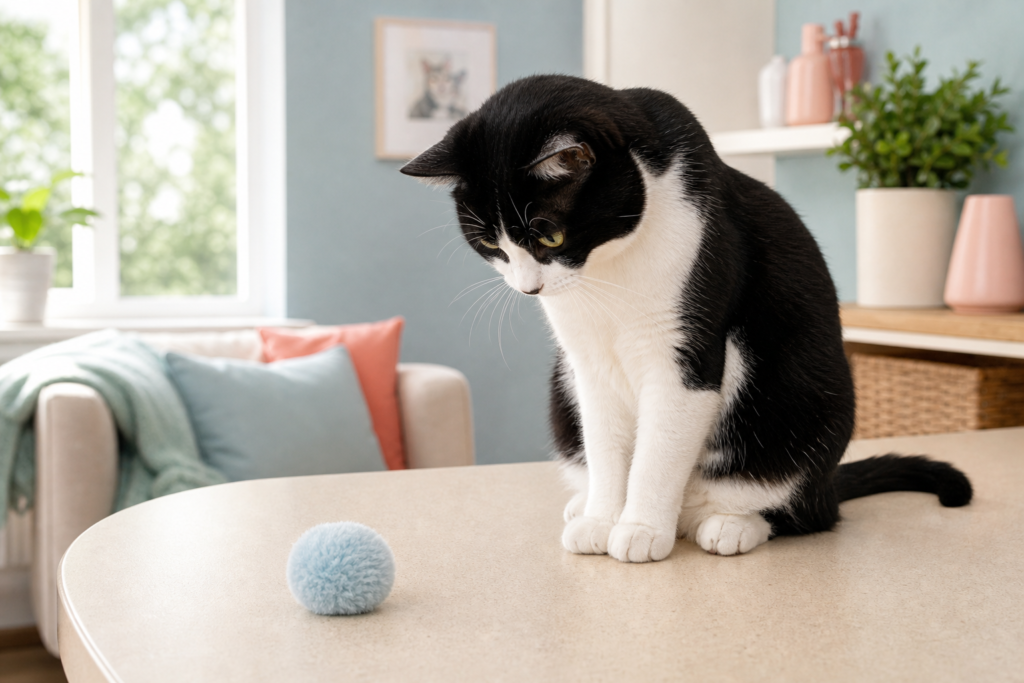
The object at the edge becomes more interesting because it is not just an object anymore. It is an object with a possible outcome. If the cat taps it, it may roll. It may wobble. It may fall. It may make a sound. It may make the human react.
That is a lot of information from one little paw.
Movement Makes Objects Worth Testing
Cats are built to notice small movement. A toy twitching across the floor, a string dragging behind a blanket, a bug crossing a window, a shadow shifting on the wall: these things can switch on a cat’s attention very quickly.
An object on a table can become interesting for the same reason. It moves when touched. It changes position. It makes a tiny sound. It may roll away like prey. It may vanish over the edge and reappear on the floor.
From a human point of view, this is annoying.
From a cat point of view, it may be a very short physics lesson with excellent feedback.
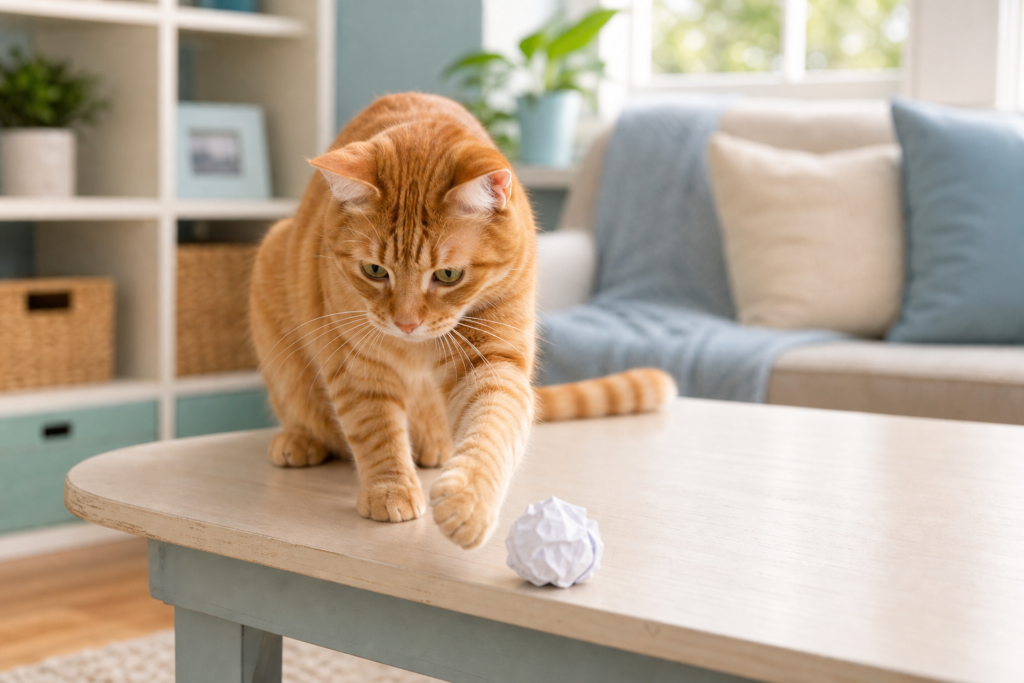
International Cat Care explains play as an important outlet for natural cat behaviour, especially when cats can stalk, chase, pounce, and complete a satisfying little sequence. Knocking an object is not the ideal version of that sequence, but the shape is familiar: notice, focus, touch, movement, result.
That is why some cats return to the same object again and again. The object does something. The cat can make it happen. The tiny experiment works.
Attention Can Accidentally Reward the Crime Scene
The other reason table-knocking becomes powerful is attention.
If a cat pushes something and the human instantly looks over, speaks, laughs, sighs, gets up, films, or says the cat’s name in that special “what are you doing” voice, the behaviour has just produced a result.
The result might not be a treat. It might not even be positive attention. But for some cats, attention is still information. The room changed because they touched the object. The human responded. The object became a button.
This does not mean your cat is plotting a full emotional campaign against your desk setup. It means cats are good at noticing patterns.
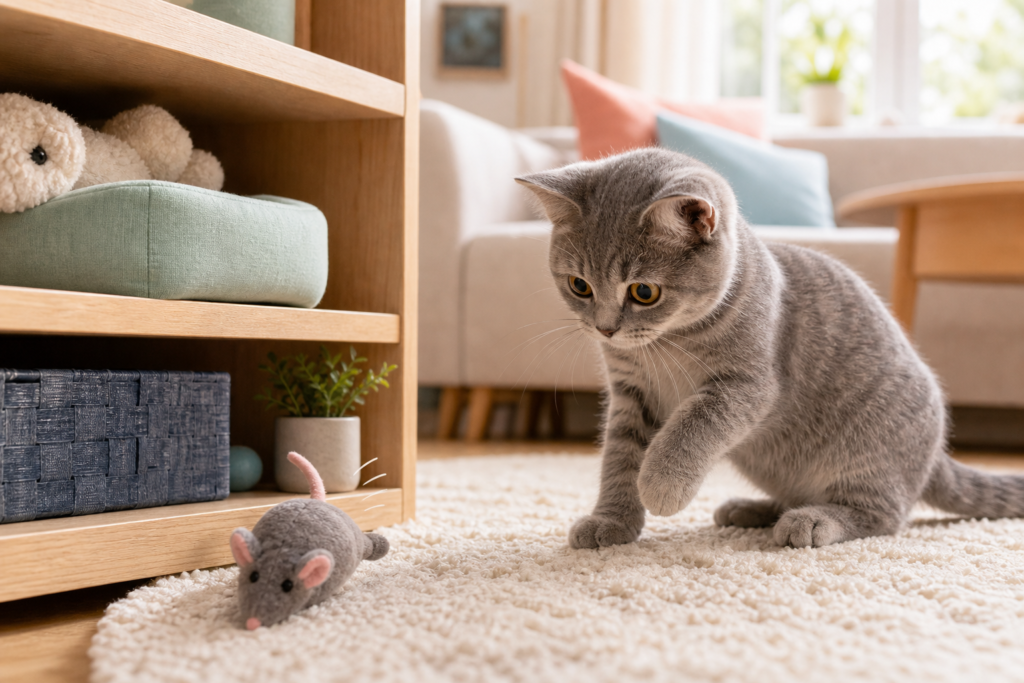
Object moves. Human reacts.
Case reopened tomorrow.
Boredom Can Turn Small Objects Into Big Events
Not every cat who knocks things off tables is bored, but boredom can make the behaviour more likely. Indoor cats especially need enough safe outlets for movement, hunting-style play, exploration, scratching, climbing, watching, and problem-solving.
If the environment is quiet and predictable, a small object near an edge can become the most interesting thing in the room.
The Ohio State Indoor Pet Initiative has long emphasised that indoor cats need environmental enrichment: places to climb, hide, scratch, play, and make choices. Without enough approved activity, cats may invent their own. Unfortunately, their version of enrichment sometimes includes your bedside table.
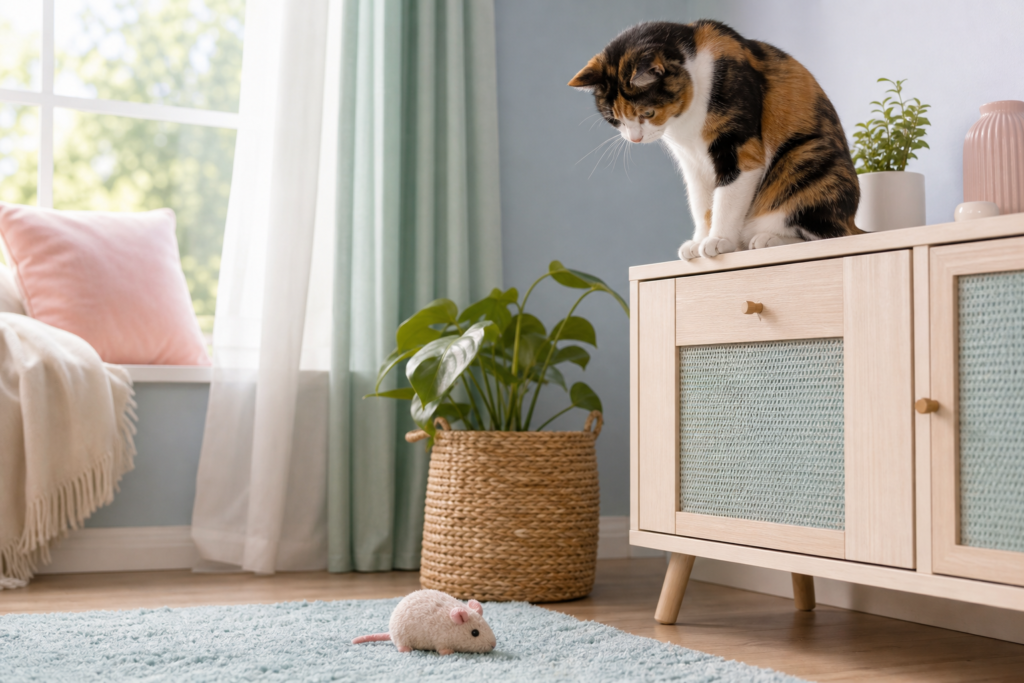
This is why the answer is usually not just “stop doing that.” The better question is:
What job is the cat trying to give itself?
Is it trying to play? Get attention? Investigate movement? Burn energy? Ask for routine? Test a new object? Interrupt your laptop because the laptop has been stealing all the attention?
The answer changes the fix.
When the Gravity Test Needs a Human Boundary
Some gravity tests are harmless. A soft toy falls. A paper ball rolls away. A cat looks pleased. Everyone survives.
Other versions are not cute. Heavy objects, glass, medication, batteries, plants, candles, sharp items, chargers, cords, food, small swallowable pieces, and fragile decorations should not be part of the experiment.
Cornell Feline Health Center’s toy safety guidance is a good reminder that cats can get into trouble with strings, small parts, loose pieces, and objects that can be swallowed. The same thinking applies to human items left on tables and shelves. If it can break, poison, choke, cut, tangle, burn, or block the gut, it should not be available for testing.
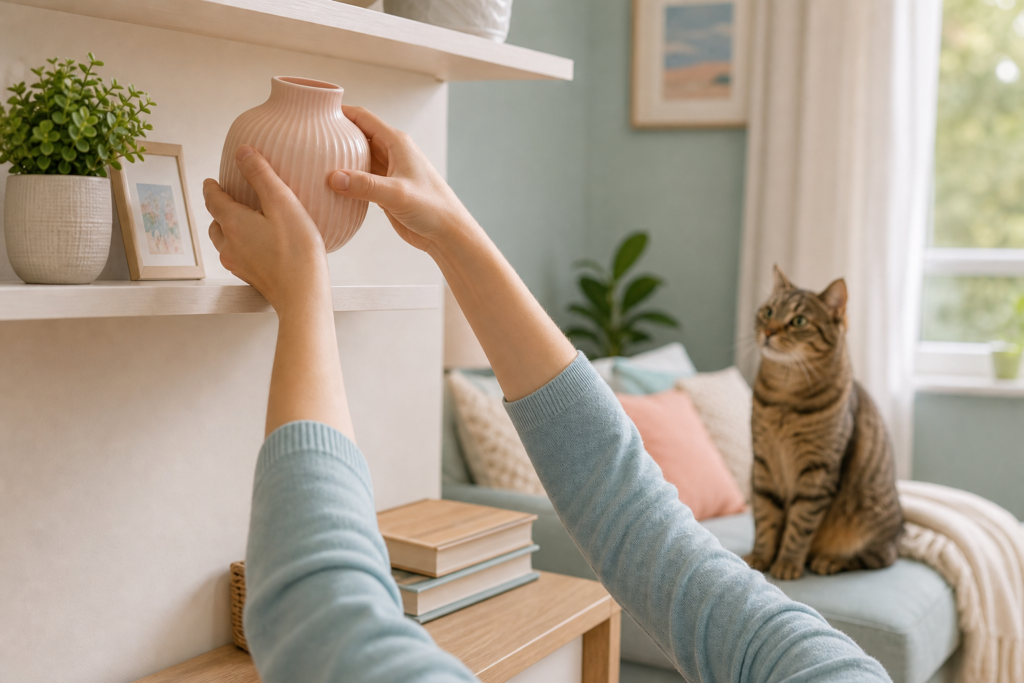
The safest version is boring:
Move risky things away.
Give the cat safe things to investigate.
Do not let the table become a tiny emergency department.
Give the Gravity Department Better Work
If a cat loves knocking things, the goal is not to remove every interesting object from life. The goal is to redirect the experiment.
Try approved outlets: wand play, soft balls, rolling toys, puzzle feeders, treat hunts, cardboard boxes, cat trees, window watching spots, scratching posts, tunnels, and short interactive play sessions. For some cats, a small tray or mat with safe toys can become an approved “testing zone.”
You can also change the attention pattern. If the cat knocks objects mostly to start a reaction, calmly remove the risky object without turning it into a whole performance, then offer a better activity later when the cat is not mid-crime.
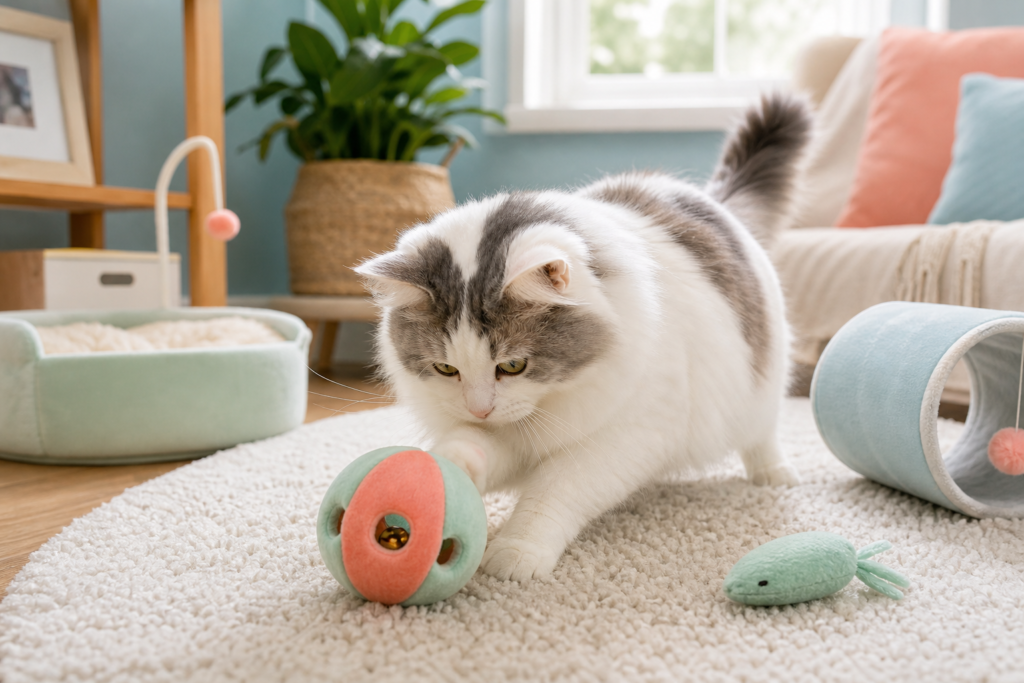
The trick is to make the better choice more interesting than the forbidden one.
Safe toy moves.
Human plays.
Cat wins.
Table survives.
More Tiny Pet Logic on CloudyAww
The funniest CloudyAww moments often happen when a pet turns a normal household object into an official assignment. A button becomes a job. A door becomes a challenge. A bag becomes evidence. A table becomes a laboratory.
That does not mean every behaviour should be ignored. Some behaviours need a safety boundary, a better outlet, or a vet check if they suddenly change. But the funny thing usually has a little logic behind it.
So when a cat knocks something off a table, the answer is probably not just “because cats are chaos.”
It is more specific than that.
The object moved. The human reacted. The room changed. The experiment produced data.
And unfortunately, the tiny gravity department may need to repeat the study.
Keep following the behaviour trail with What It Means When Cats Choose the Worst Shortcut, Tiny Guide To Cat Night Zoomies, and What to Do When Your Cat Scratches the Sofa. More warm, practical pet explainers live in Aww Articles.