The little tap has range
Some dogs bark. Some dogs stare. Some dogs place one paw on your arm with the seriousness of a tiny courtroom objection.
A paw can be funny because it feels so human. One soft tap, one focused face, and suddenly the dog appears to have opened a meeting.
But pawing does not have one fixed meaning. It can be attention, habit, affection, play, a request, uncertainty, excitement, frustration, stress, or a learned button that works beautifully on humans.
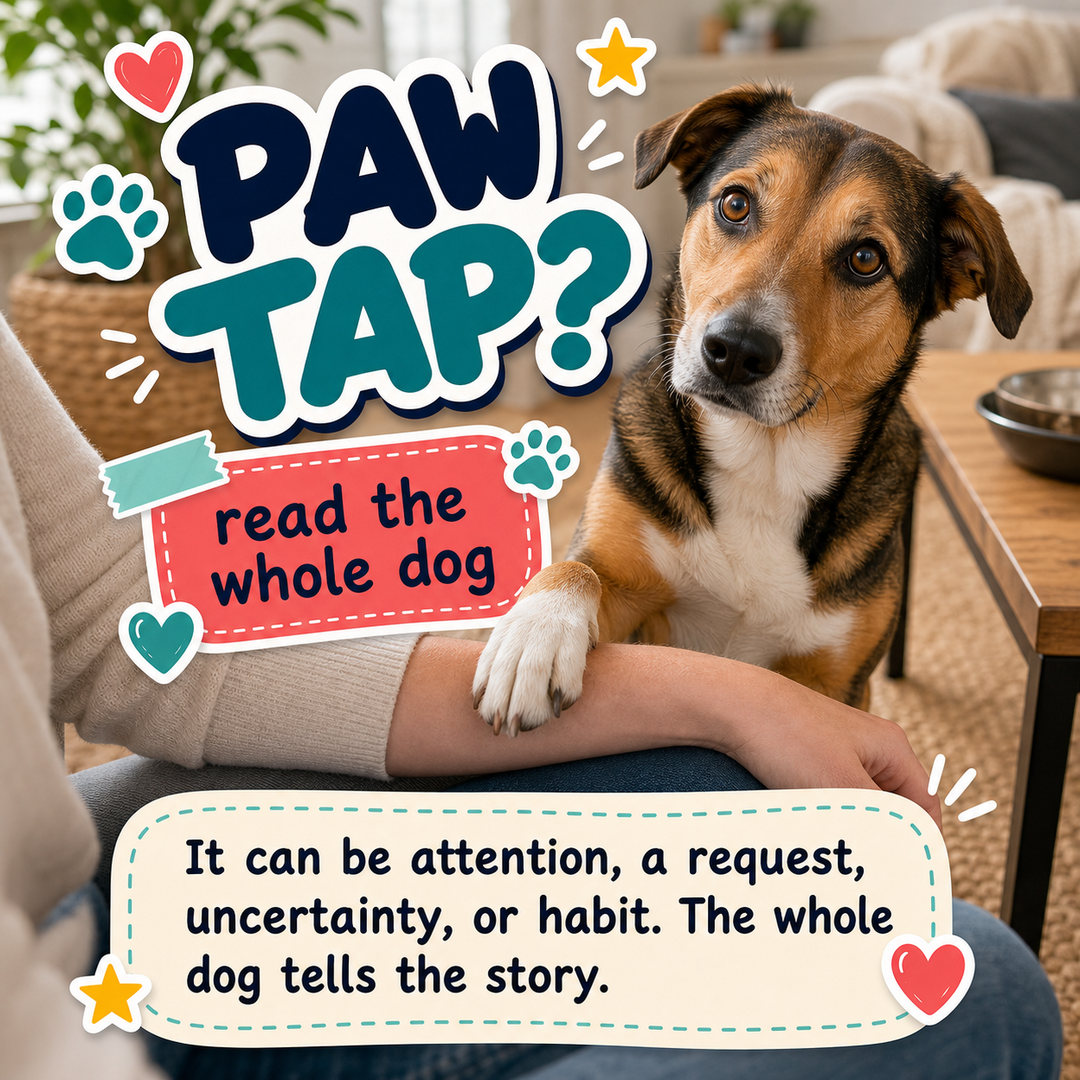
The useful question is not “what does pawing always mean?” The better question is: what is happening around the paw?
Look at the whole dog, the timing, the place, the person, and what happens next. That is where the real clue usually lives.
First, read the whole dog
A paw is only one piece of body language. The same paw on your knee can mean different things depending on the rest of the dog.
A loose dog with soft eyes, wiggly body, relaxed mouth, and a wag that moves through the hips may be asking for attention, play, or a familiar routine. A stiff dog with a tense face, tucked tail, pinned ears, lip licking, whale eye, freezing, or a body leaning away may be showing uncertainty instead.
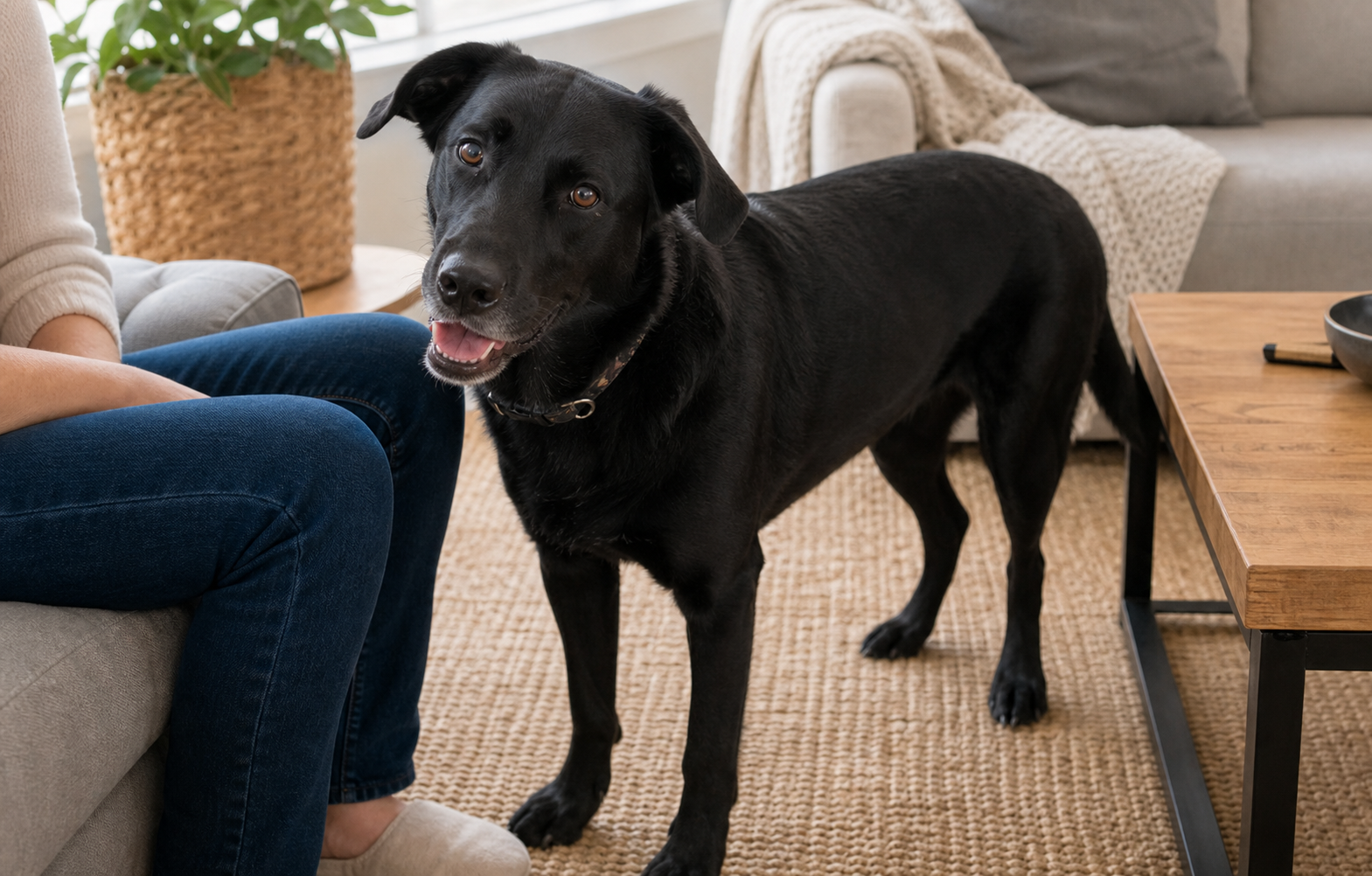
This is why volume and cuteness can trick us. A gentle paw may look polite, but the dog might still feel unsure. A dramatic paw may look needy, but the dog may simply have learned that this is the fastest way to make the human look up.
The paw is the headline. The whole body is the article.
Sometimes the paw says, “notice me”
For many dogs, pawing is a social nudge. It can mean, “hello, I am here,” “please continue,” or “the petting department appears to have closed early.”
This kind of pawing often happens during calm attention. You stop rubbing the dog’s chest, and a paw appears. You look away, and the paw lands on your arm. You sit down with a drink, and the dog gently adds one paw to the conversation.
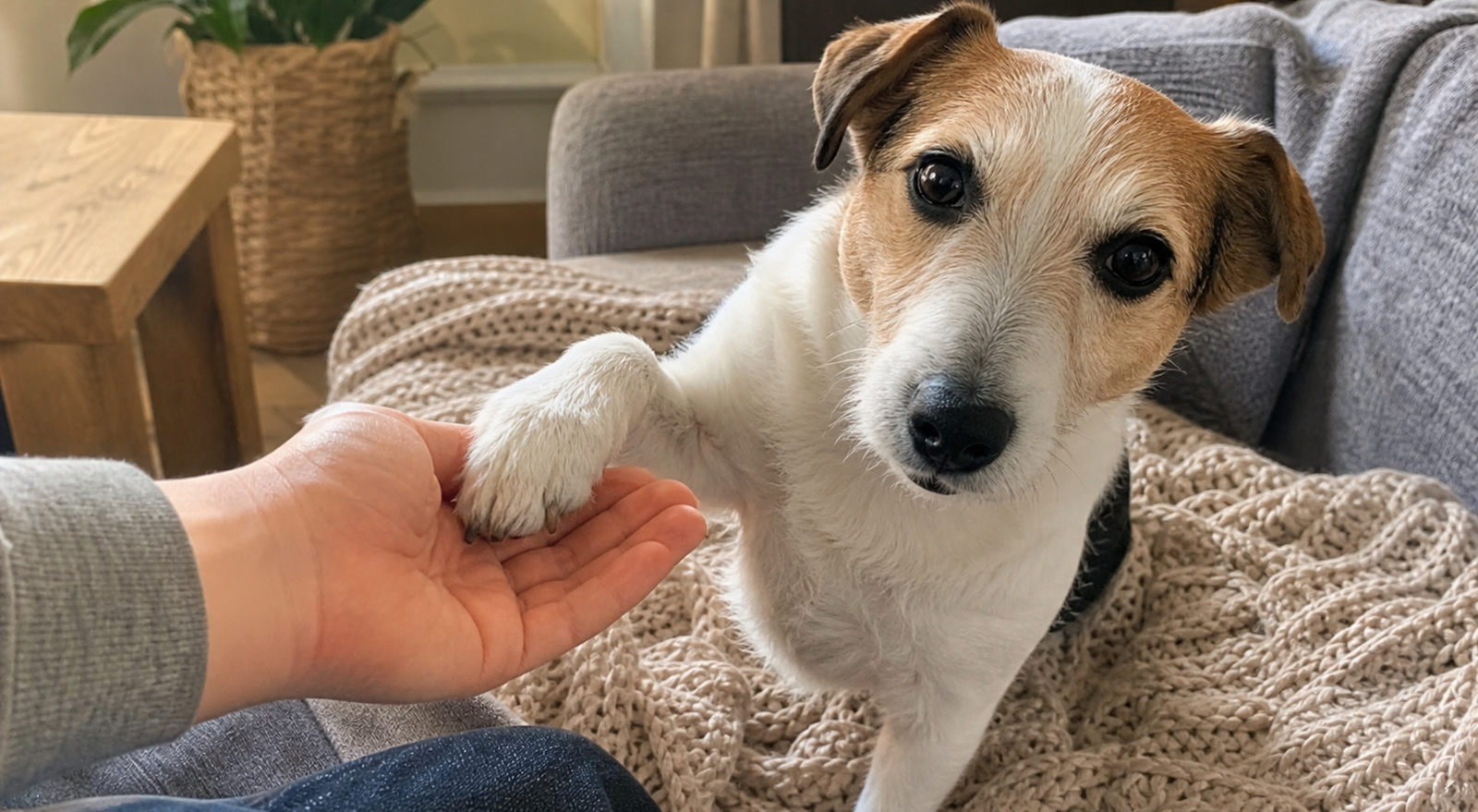
That does not make the dog bad or manipulative. Dogs are excellent at repeating behaviours that get results. If the paw makes a person smile, speak, touch, feed, move, or laugh, the paw has learned something useful.
If the behaviour is sweet and harmless, you can enjoy it. If it becomes constant, scratchy, pushy, or inconvenient, teach a clearer alternative: sit beside me, chin rest, go to mat, bring a toy, or settle near your feet.
The goal is not to remove communication. It is to give the dog a way to communicate that works for both of you.
Sometimes it is a request with a tiny hand
Dogs may paw when they want something specific: a door opened, a toy rescued, dinner prepared, the blanket adjusted, a lap invitation, or the mysterious object under the sofa returned to public life.
Timing matters. If the paw happens near the door, before a walk, beside the food area, or next to a stuck toy, it may be less about affection and more about a practical request.
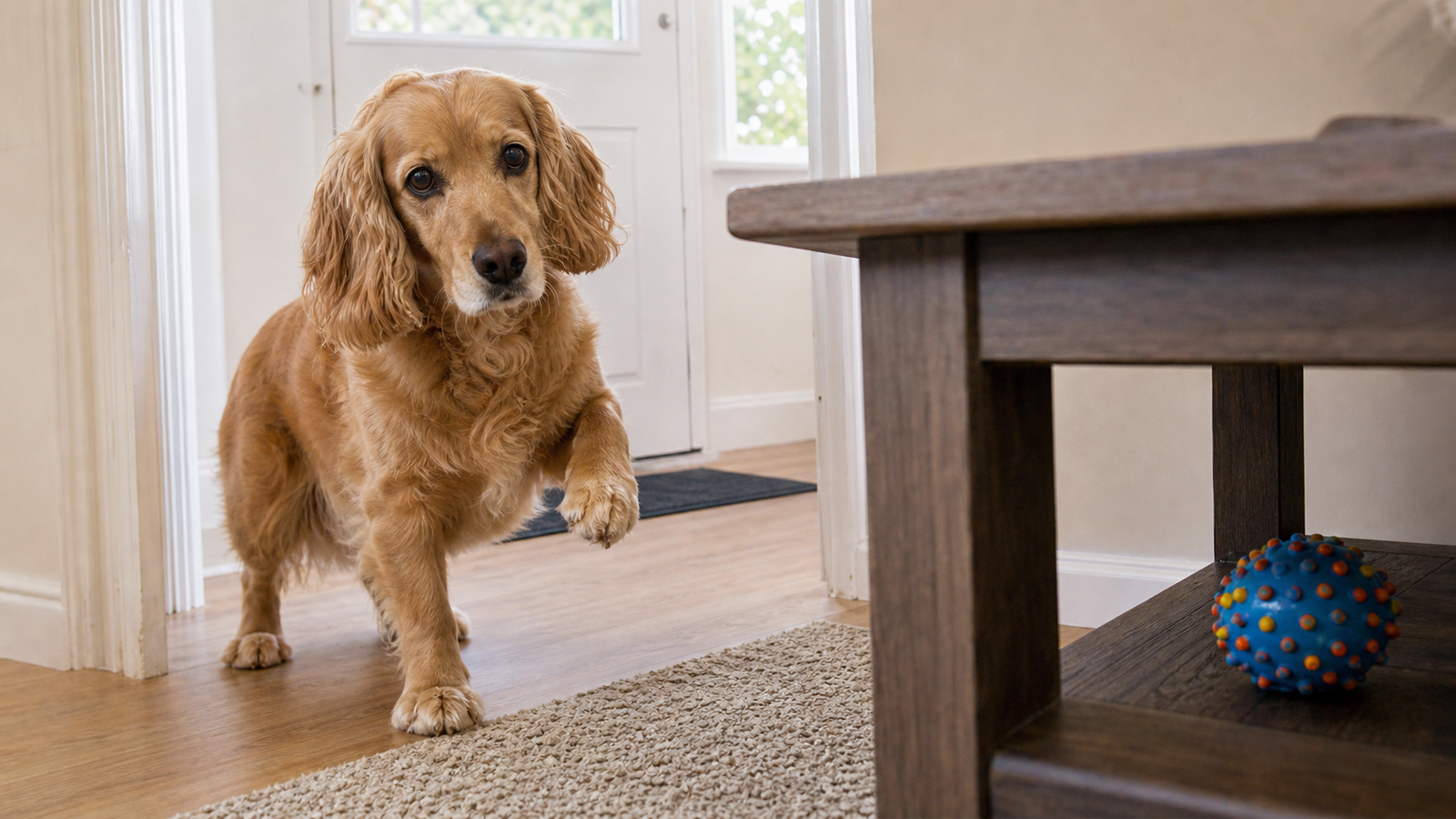
Again, the dog is not speaking English. They are using a behaviour that has a history. Paw plus door may have led to outside. Paw plus bowl may have led to dinner. Paw plus toy may have led to a human crawling under furniture like a low-budget rescue team.
If you want to reduce pawing, avoid rewarding the paw every time. Pause. Ask for a calmer cue you like. Reward that instead. Over time, the dog learns which version of the request gets the good result.
Sometimes it is uncertainty, not confidence
A lifted paw can also appear when a dog is unsure. Some dogs raise a front paw during moments of hesitation, conflict, or mild stress. It may come with a lowered body, stillness, soft blinking, looking away, lip licking, or a cautious approach.
This is where people sometimes misread the moment. A dog who paws at a person, visitor, child, groomer, or other dog is not always being friendly. They may be testing the situation, asking for space, or trying to make something stop without escalating.
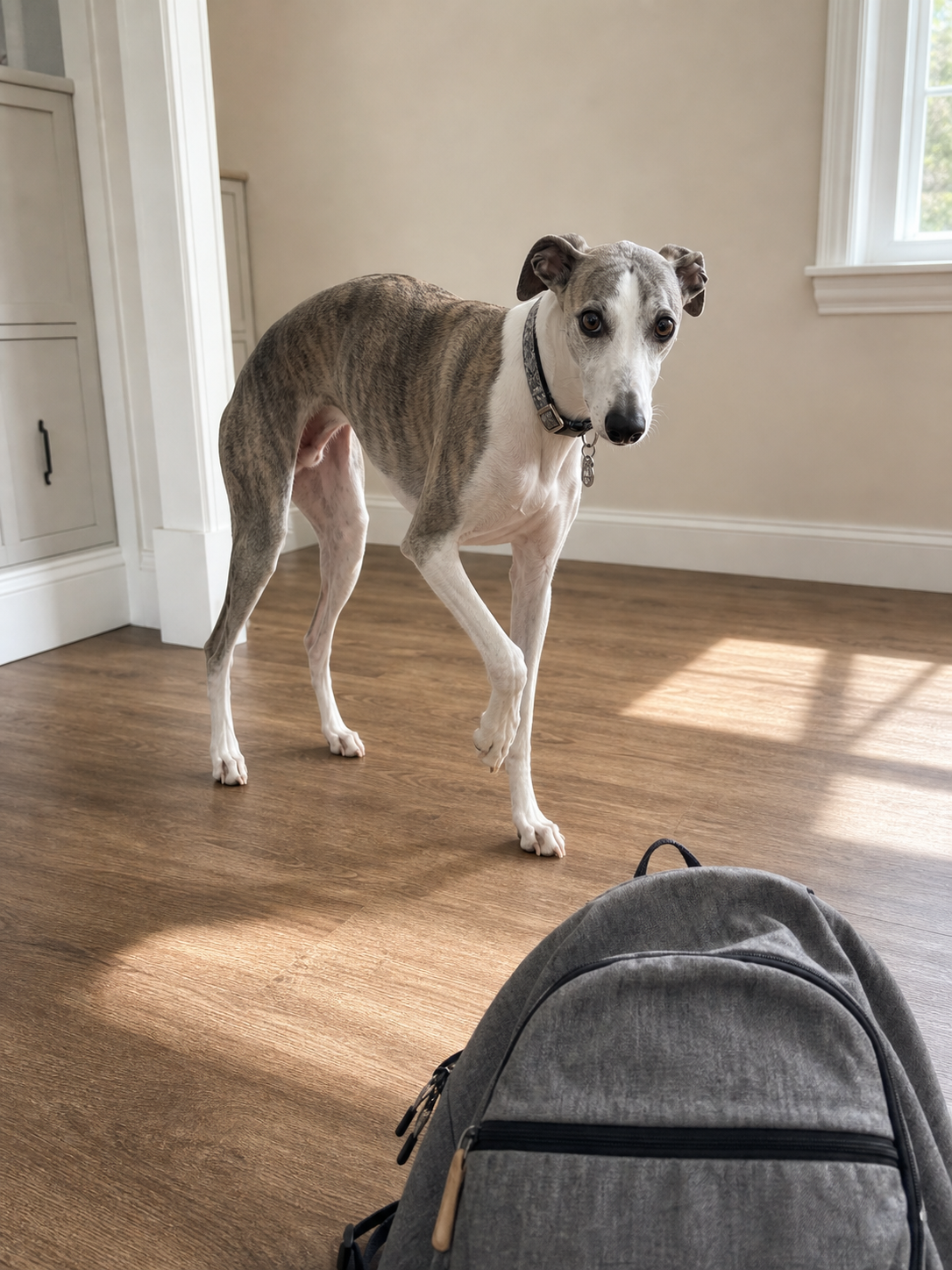
If the paw comes with stiffness, avoidance, freezing, tucked posture, growling, hiding, or repeated attempts to leave, do not force more contact. Give the dog space. Let them move away. Slow the situation down.
The CloudyAww version: sometimes the paw is not a handshake. Sometimes it is a tiny “can we not?”
Pawing can become a learned button
Dogs are very good household scientists. They notice what works.
If pawing makes the human immediately look up, talk, touch, feed, laugh, open a door, or stop using a laptop, pawing becomes useful. That is especially true if the response is dramatic. Even “stop that” can still be attention.
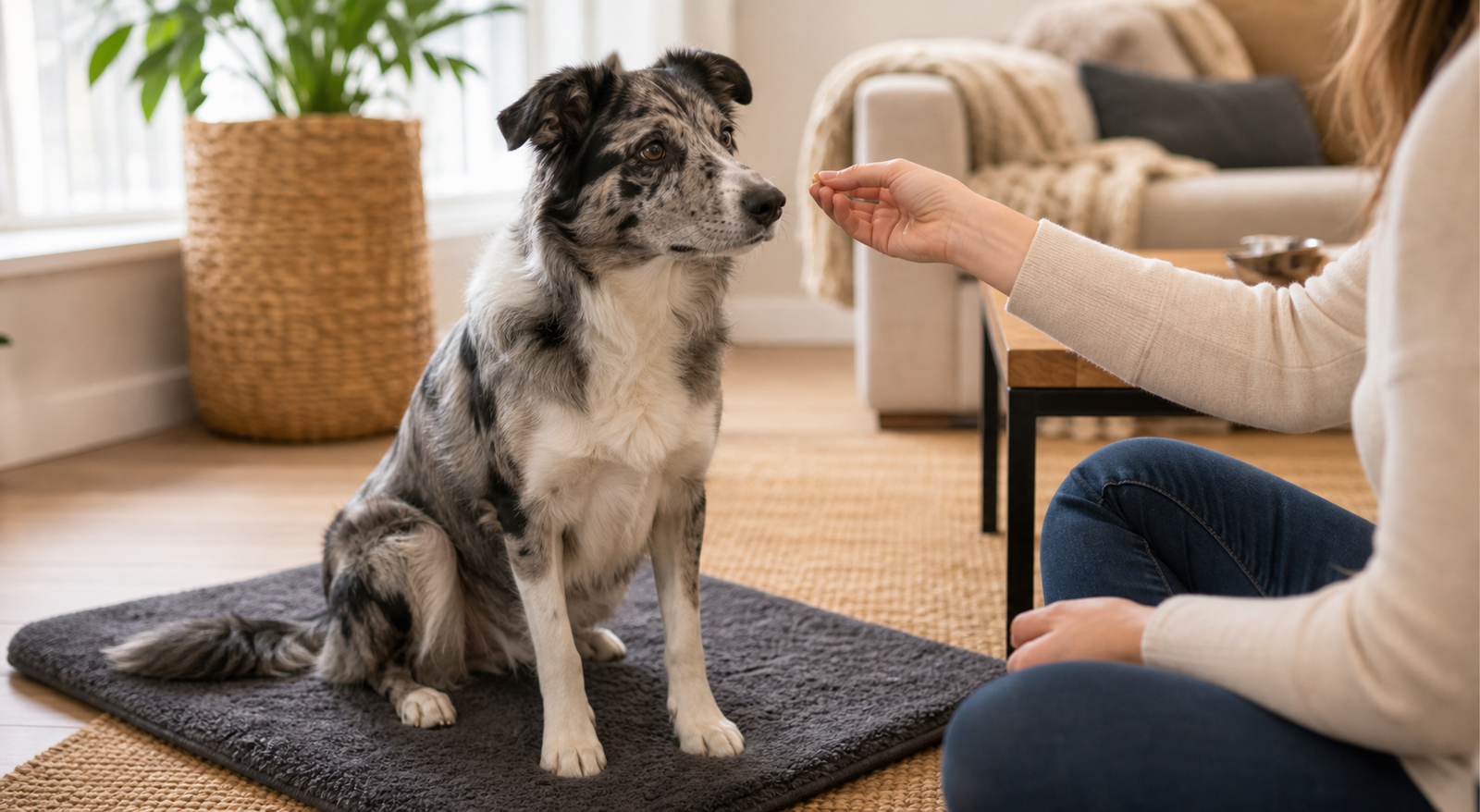
This does not mean ignoring every paw forever. It means choosing what you want to reinforce. If your dog paws gently once and you like it, fine. If the paw becomes a repeated scratch machine, wait for a calmer moment and reward that.
Useful alternatives include:
– sitting quietly before attention;
– placing chin on a cushion;
– touching a hand target;
– going to a mat;
– bringing a toy;
– waiting while you finish something.
Dogs do better when the replacement behaviour is clear. “Do not paw” is less useful than “put your chin here” or “sit beside me.”
When the paw may be a pain clue
Not every paw moment is communication with a human. Sometimes a dog is focused on the paw itself.
Watch for licking, chewing, holding one paw up repeatedly, limping, swelling, redness, heat, broken nails, sudden sensitivity, yelping, reluctance to walk, or a dog who suddenly paws at people after normal touch used to be fine.
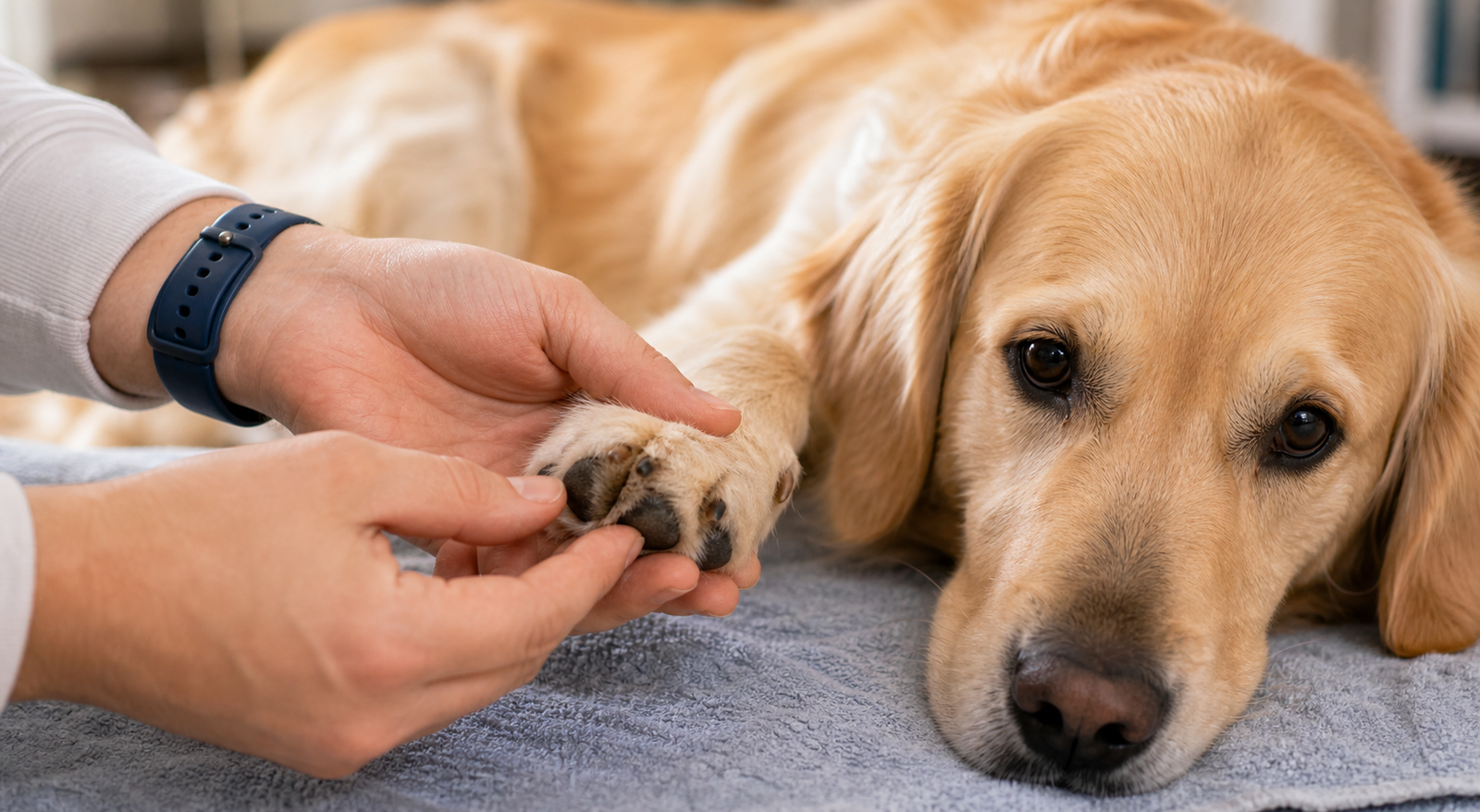
A dog who offers a paw because they learned a trick is different from a dog who cannot comfortably put weight on that paw. A dog asking for attention is different from a dog trying to show you something hurts.
If pawing is sudden, paired with lameness, linked to touch sensitivity, or comes with a behaviour change, ask a vet. Behaviour can change when the body feels different.
How to respond without making it weird
Start by naming the pattern for yourself. When does the paw happen? Who is present? What does the dog look like? What happens right afterward?
If the dog is relaxed and pawing for attention, decide whether you like it. If yes, keep it gentle and occasional. If no, teach a replacement and reward the calmer version.
If the dog is pawing for something specific, make the request predictable. Ask for a sit, hand target, or mat before opening the door or handing over the toy.
If the dog looks worried, do not punish the paw. Add distance, reduce pressure, and make the situation easier.
If the dog may be sore, skip the behaviour theory and check the body.
The best response is not one rule for every paw. It is matching your response to the dog in front of you.
The CloudyAww read
A dog paw can be adorable, bossy, careful, hopeful, worried, or beautifully over-rehearsed.
Sometimes it says, “please continue.” Sometimes it says, “I require assistance.” Sometimes it says, “this situation is confusing.” Sometimes it says, “I have trained this human extremely well.”
The sweet spot is to listen without overreacting. Notice the whole dog. Reward the communication you want. Respect the paw if it comes with worry. Check for pain if the behaviour changes.
And if your dog places one paw on your arm like they are about to deliver a formal complaint, yes, it is funny.
But under the tiny tap, there is usually a real little message worth reading.
More tiny pet logic lives across CloudyAww, where the funniest animal moments usually have a small real reason hiding underneath them.
Keep following the behaviour trail with Tiny Guide to Dog Body Language: Tail, Ears and Tiny Pauses, Why Dogs Shake Off When They Aren’t Wet, and Why Dogs Bring You Toys When You Come Home. More warm, practical pet explainers live in Aww Articles.
Sources and Further Reading
- AKC: Why does my dog put a paw on me?
- VCA Animal Hospitals: Interpreting canine communication
- VCA Animal Hospitals: First aid for limping dogs
- Blue Cross: How to read dog body language