
Pets are not reading the script in our head. They are reading the signals we actually give them.
Pets often seem to misunderstand us, but they may be reacting to tone, timing, body language, routine, attention, or reward instead of the full meaning we intended.
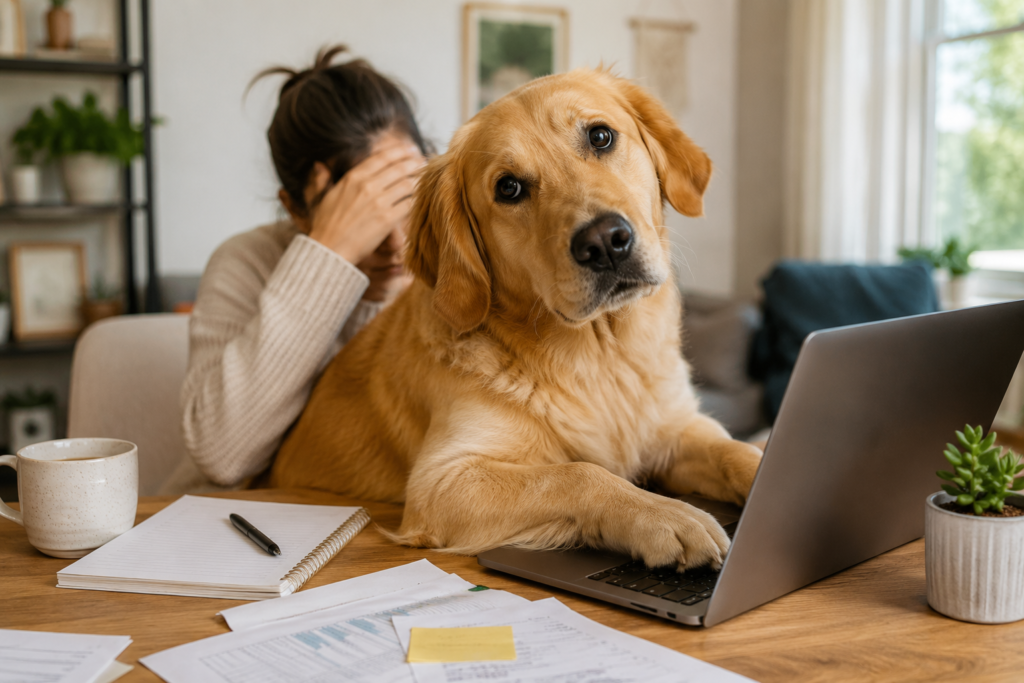
You ask your dog to move away from the laptop. He hears “place both paws directly on the keyboard and look helpful.”
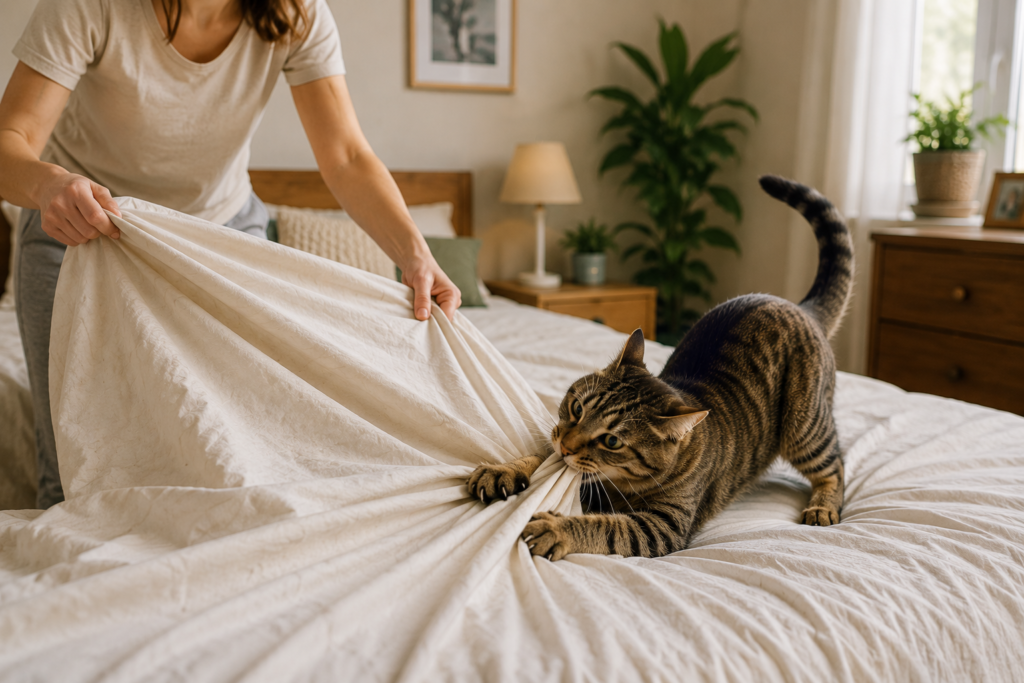
You try to make the bed. Your cat sees a moving blanket and decides the project clearly needed claws.
From our side, the assignment was simple. From their side, the message may have arrived with half the instructions missing and several extra signals accidentally attached.
Why pets misunderstand us starts with the signals we accidentally send?
One reason pets misunderstand us is that they are often paying attention to details we barely notice.
A person might think, “I told him to get down.”
The dog may have noticed the raised voice, the hand movement, the laptop, the chair, the fact that this usually happens before attention, and the tiny gap where he has previously been rewarded with eye contact. To us, the message was one instruction. To him, it may have arrived as a pile of mixed signals.
Dogs are especially good at watching people. Research published in Scientific Reports found that dogs could behave differently when a human intentionally withheld a reward compared with when the human seemed unable to give it. That does not mean dogs understand every human intention perfectly, but it does suggest they are paying close attention to the difference between what people do and what people seem to mean.
This is where everyday confusion begins.
A pet may not be ignoring the assignment. They may be responding to the wrong part of it. The sound of your voice, the direction of your hand, the object in front of you, the routine that usually happens next, or the reward they remember from last time may all matter more than the sentence itself.
So when a dog climbs onto the laptop instead of moving away from it, the logic may not be: “I refuse your request.”
It may be: “This glowing rectangle has all your attention, and I have placed myself exactly where attention lives.”
Watch the tiny assignment fail
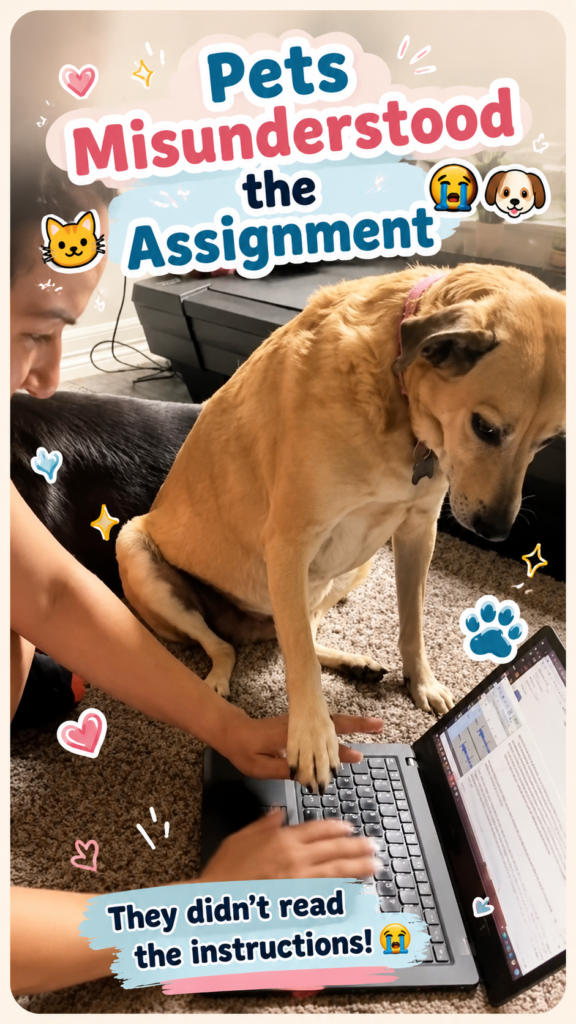
The Short that inspired this article shows the idea in miniature: a simple human task, a very confident pet, and one very different interpretation of “helping.”
Tap below to watch the
assignment gently collapse:
Cats are not ignoring the brief. They may be reading a different contract
Cats can make misunderstandings look personal.
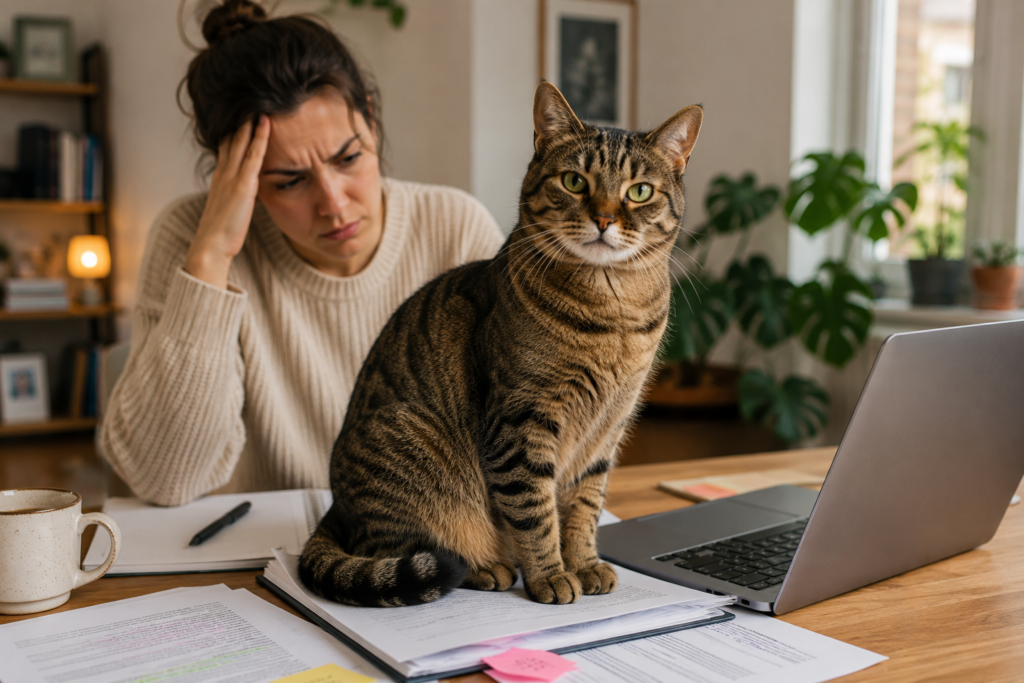
You move a laptop. The cat sits on it. You clear a table. The cat walks across it. You try to fold laundry. The cat appears inside the pile as if this was always the agreed plan.
It is tempting to treat that as defiance, but cats often work from a different communication map than humans. They pay close attention to space, scent, body position, routine, touch, movement, and control. A cat may not care about the “task” in the human sense. The cat may care that the task has created a warm surface, an interesting texture, a moving object, or a place where human attention is suddenly concentrated.
Human-cat relationships also depend heavily on how people handle and read cats. Research in Frontiers in Veterinary Science found that practical handling guidelines could increase friendly cat behaviour and reduce conflict signs during interactions. In plain English: when humans change the way they communicate, cats often respond differently.
That matters because a cat sitting on your paperwork may not be asking, “How can I ruin this?”
The question may be closer to: “Why is all your attention on this flat thing, and why was I not consulted?”
Why pets “help” by making the task worse
A lot of pet misunderstandings happen during ordinary human tasks: working, folding laundry, making the bed, unpacking bags, cleaning the floor, sorting papers, cooking dinner.
To us, these are jobs.
To a pet, they may look like invitations.
A moving blanket is not “bed-making.” It is a giant rustling creature that clearly needs to be attacked. A pile of clean laundry is not a finished chore. It is a warm, scented mountain of familiar humans. A laptop is not a work tool. It is the glowing rectangle that keeps stealing the person’s face.
This is why pets often seem to “help” in the least helpful way possible. The task has texture, movement, smell, sound, and attention. Those are all interesting signals.
Dogs may join because they are social and want to be near the action. Cats may join because the object is warm, elevated, moving, or placed in a socially important spot. Neither animal needs to understand your deadline to understand that something interesting is happening.
And sometimes, without meaning to, we reward the interruption. We laugh. We talk to them. We move them gently. We film it. We say their name seventeen times.
From the pet’s point of view, the assignment may have gone beautifully.
How to make the assignment clearer
The good news is that pets can often understand us better when we make the message simpler.
That does not mean turning your home into a training academy with clipboards and whistles. It usually means being more consistent with the tiny signals around the task.
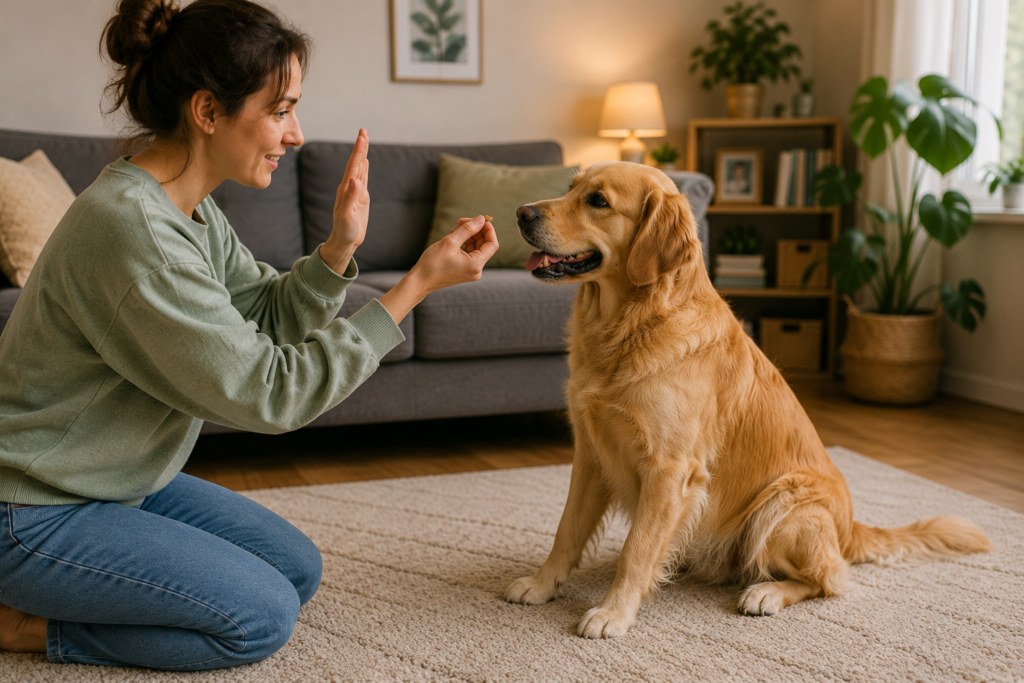
If you want your dog off the laptop, reward the moment he chooses the floor, the bed, or another clear spot. If you laugh, talk, film, and gently wrestle him away every time he climbs into the work zone, the laptop may become part of a very successful attention game.
If you want your cat away from the paperwork, give them a better option before the papers become interesting. A nearby blanket, perch, cardboard scratcher, or warm bed can sometimes redirect the tiny office supervisor before they sit directly on your tax documents.
Timing matters too. Pets learn from what happens immediately after a behaviour. If the “wrong” behaviour creates attention, movement, food, play, or a new game, it may accidentally become worth repeating.
Clearer communication often comes down to three things:
Keep the cue simple.
Reward the exact behaviour you want.
Make the better choice easier than the chaotic one.
That last part is important. Pets are not reading the private meeting notes inside our heads. They are reading the room, the routine, the reward, and the little signals leaking out of us while we try to get something done.
The funny part is not that pets are broken
When pets misunderstand us, it is usually not because they are plotting against the household schedule.
Usually, the translation layer is just fuzzy.
We think we are giving one clean message. They may be reading tone, routine, body position, scent, movement, warmth, reward history, and whatever strange emotional weather is happening around the task.
That is why a dog can look deeply proud after doing the wrong thing. That is why a cat can sit on the exact paper you needed and seem completely at peace with the decision. From their point of view, the assignment may not have failed. It may have become more interesting.
And honestly, that is part of why we love them.
Pets bring their own logic into human life. Sometimes it is inconvenient. Sometimes it is chaotic. Sometimes it puts paws on the keyboard at the worst possible moment.
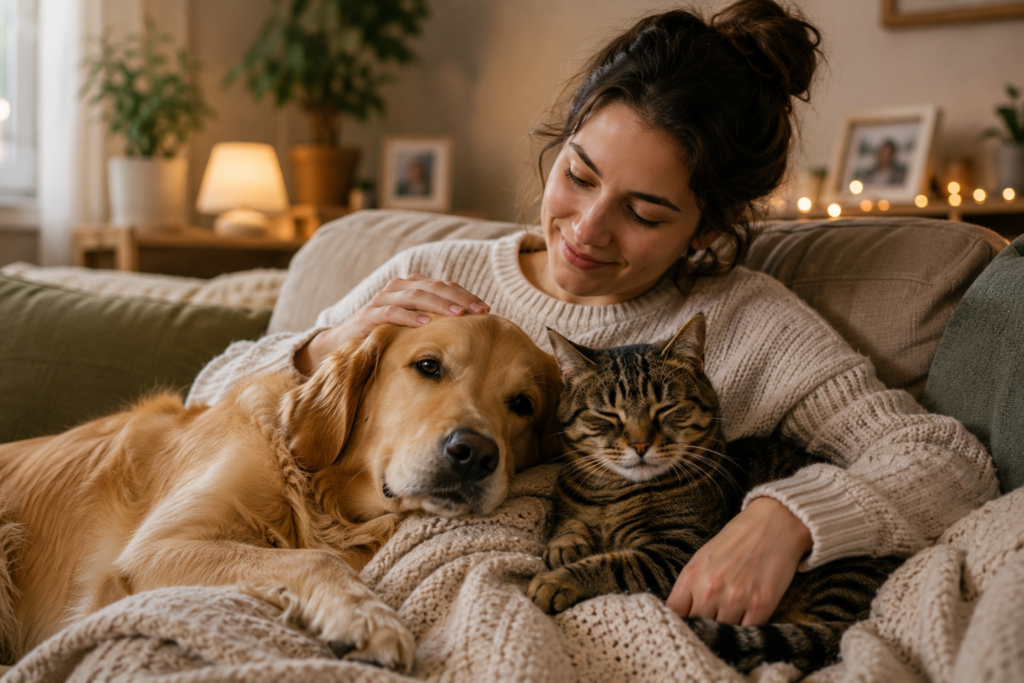
But every little misunderstanding is also a reminder that we share our homes with animals who are constantly trying to read us, join us, and make sense of our very strange human routines.
They heard the assignment.
They just translated it into pet.
A tiny CloudyAww note
CloudyAww is built around these tiny animal translation errors: the confusing ones, the dramatic ones, and the ones that somehow make perfect sense once you remember pets are reading the world through their own soft little operating system.
If your dog has ever “helped” by standing on the thing you needed, or your cat has ever turned your serious task into furniture, you are not alone. The assignment was simply processed through pet logic.
Keep following the behaviour trail with What It Means When Pets Try to Use Human Things, Why Do Pets Turn Small Moments Into Big Drama?, and Why Dogs and Cats Demand Attention: The Cute Reason Pets Act So Dramatic. More warm, practical pet explainers live in Aww Articles.