

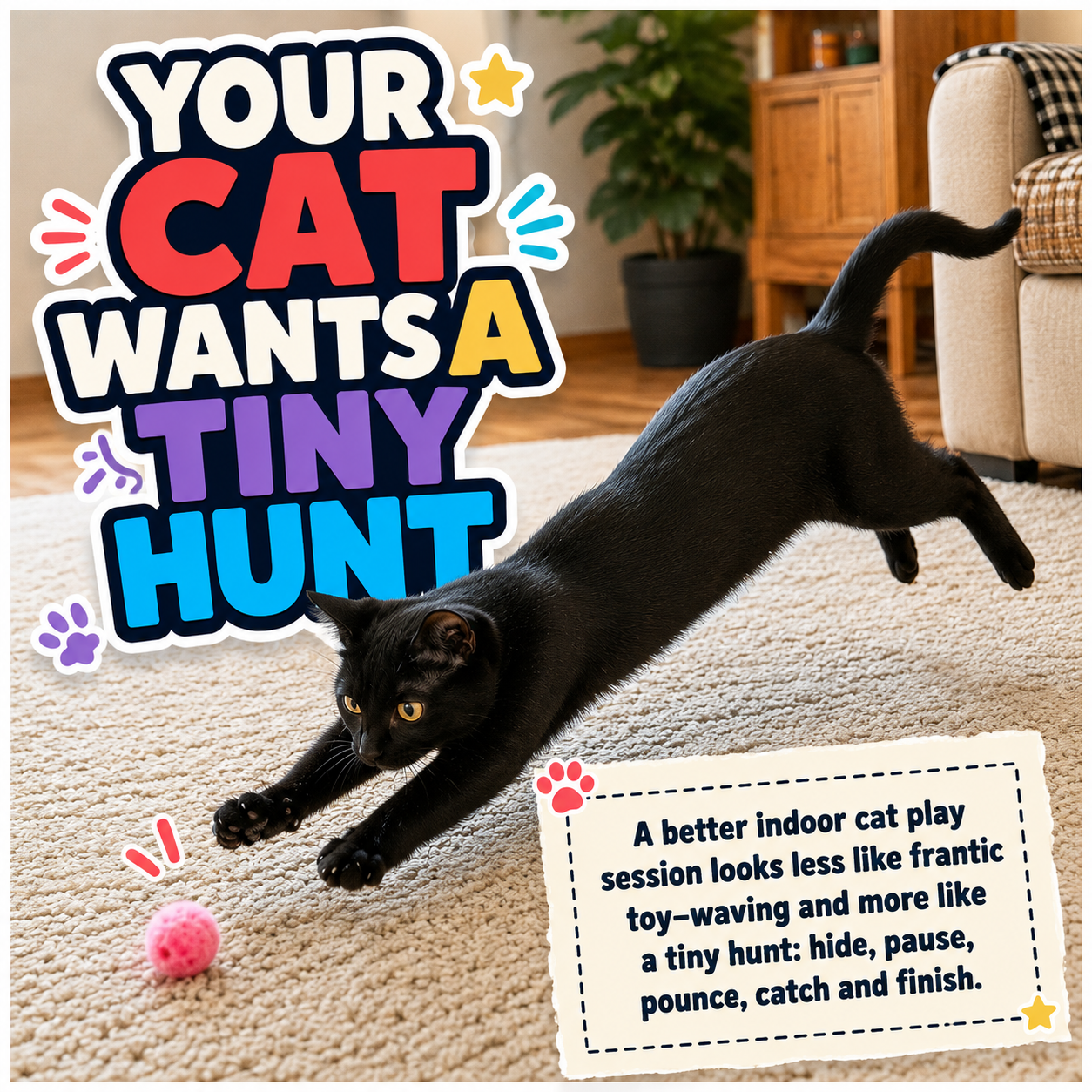
Some cat play sessions begin with excellent intentions and end with a human doing frantic wrist cardio while the cat watches from under a chair.
The toy is moving. Technically, the cat is present. Yet the atmosphere suggests an unpaid meeting.
Often, the missing ingredient is not a more expensive toy or a longer session. It is a better tiny story. Cats are built to notice small movement, wait, stalk, chase, pounce and catch. A toy that behaves like prey can invite those behaviours. A toy that repeatedly lands on the cat’s face may simply feel like very irritating weather.
The useful question is not only, “How much should I play with my indoor cat?” It is: does the session give this particular cat something worth watching, planning and catching?
A good play session does not need to be an Olympic event. It needs a beginning, a little suspense and an ending the cat is allowed to understand.
Make the Toy Worth Hunting

Before the first pounce, there is usually a reason to pay attention.
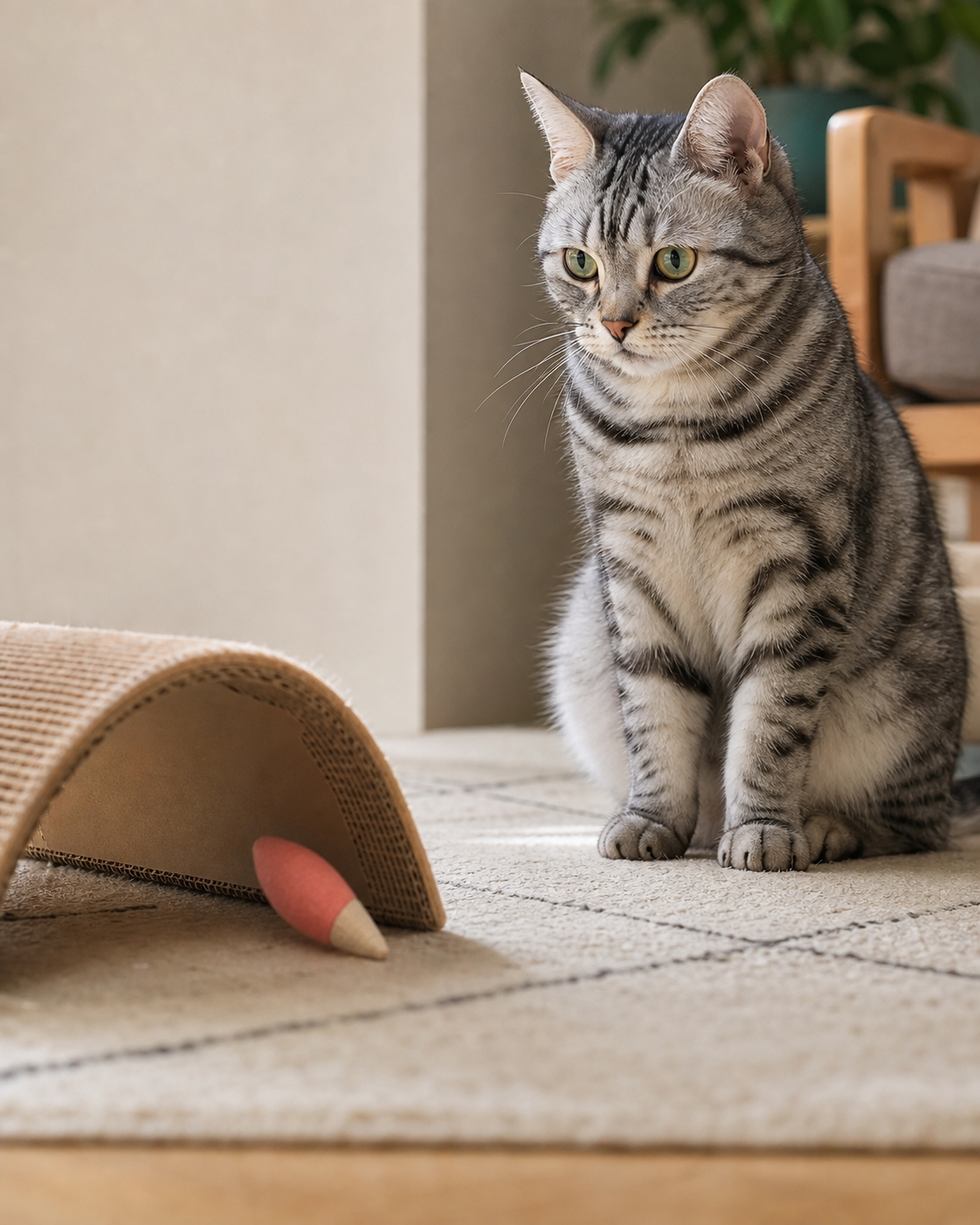
Try moving a wand toy away from the cat rather than directly at them. Let it disappear around a chair leg, slide behind a paper bag, tremble at the edge of a rug or pause beneath a light cloth. Small, irregular movements can look more interesting than fast circles in open space.
Think mouse, moth or tiny creature with questionable paperwork. Prey does not normally fly into a cat’s forehead six times and ask whether the cat is having fun.
Different cats prefer different games. One may love a feather moving through the air. Another may ignore anything airborne but launch magnificently at a fabric strip dragged along the floor. Some prefer a soft mouse, a rolling ball or a treat puzzle they can investigate alone.
The goal is not to find the universally best toy. There is no feline board meeting that approved one. The goal is to notice what your cat chooses: high or low, fast or slow, noisy or quiet, hidden or visible.
Let the Stalk Happen

Stillness can be part of play.
A cat who crouches, stares, shifts their weight or wiggles before a pounce has not necessarily become bored. They may be doing the most cat part of the entire session: watching and planning.
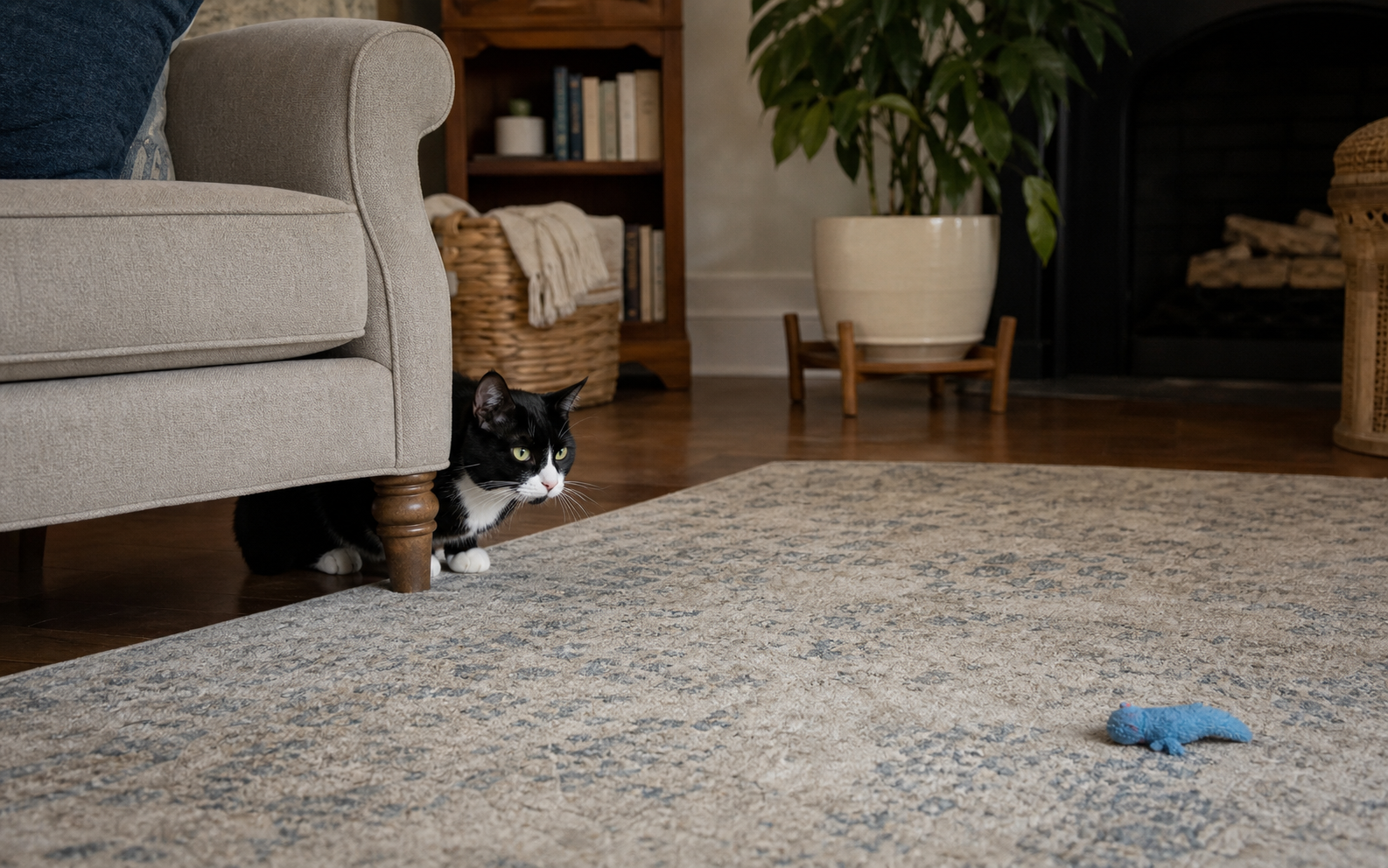
If the toy never pauses, disappears or changes direction, the cat has little chance to stalk it. Move, stop, hide, wait. Let the cat decide when the chase begins.
This can be especially useful for a cautious cat. Instead of pushing the toy closer, make it smaller and less intrusive. Keep it near cover. Move it away. Give the cat an open route to approach or leave. Interest may show up as one ear turning, pupils changing, a head following the movement or a paw slowly reaching out.
Not every session needs an immediate airborne leap. Sometimes the first successful game is simply: the cat watched, chose to join and did not feel chased by the toy.
The Catch Is Part of the Game

If the cat can never catch the toy, the game can become a chase with no conclusion.
Feline environmental-needs guidance recommends giving cats opportunities for predatory play and allowing them to capture the “prey” at least sometimes. In practical living-room terms: let the toy lose.
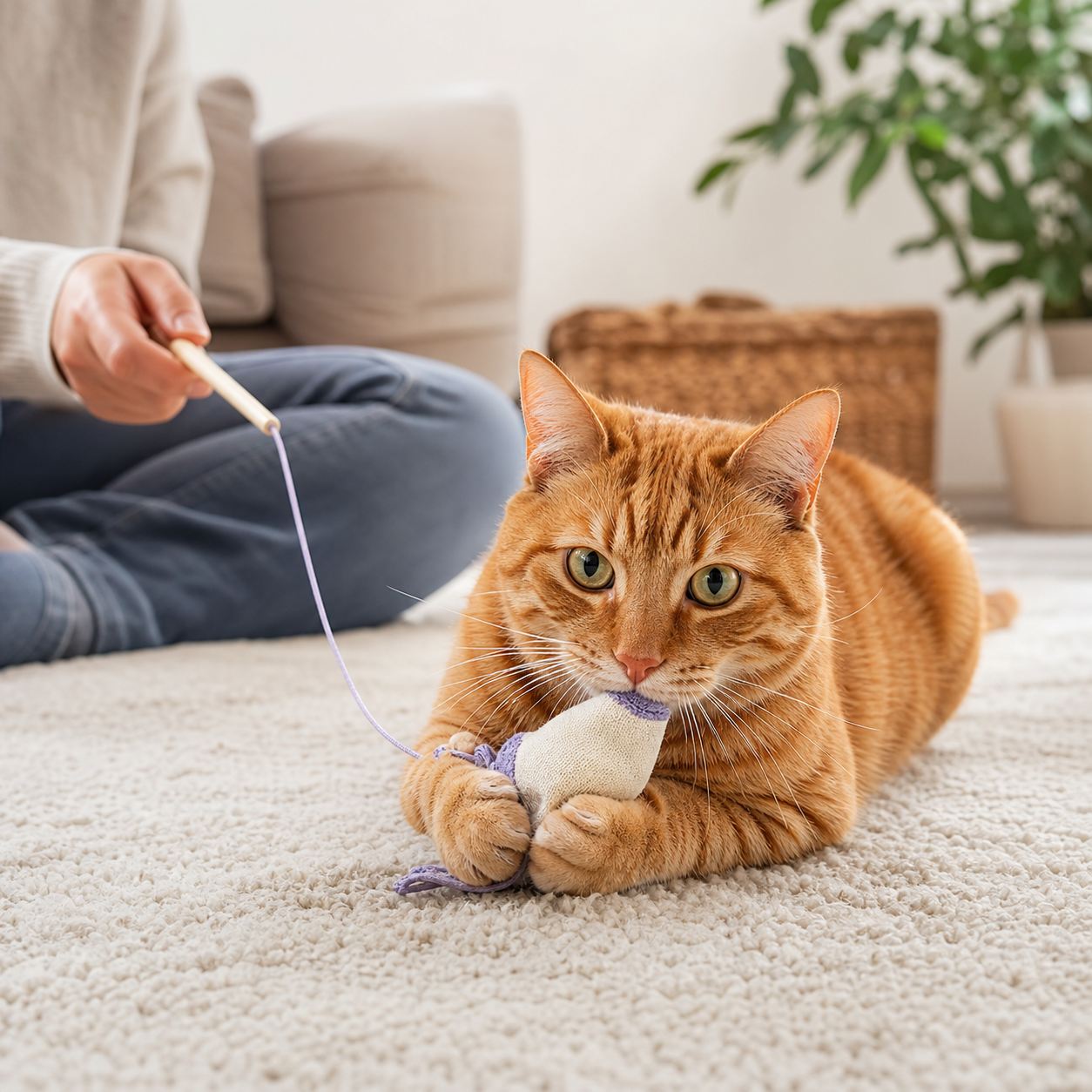
After a chase or pounce, stop pulling for a moment. Let the cat pin, bite or bunny-kick an appropriate toy. If they release it and look ready, make it twitch away again. Near the end, slow the movement, offer a final catch and let the toy become still.
Some cats enjoy a small portion of their usual food, a treat or a puzzle feeder after play. That can create a neat routine, but it is optional and should fit the cat’s normal diet. The essential part is not a ceremonial snack. It is that the session does not end with the interesting thing vanishing at the exact moment the cat finally succeeds.
Laser pointers need extra care because there is nothing physical to catch. If you use one, guide the cat toward a real toy or safe food reward they can physically reach, then end the laser game. Never shine a laser toward eyes.
Short Can Still Feel Full

Cats often play in bursts. A useful session can be surprisingly short.
Cats Protection notes that even one- or two-minute games can be worthwhile, and that younger cats may want more frequent opportunities than older cats. That is more helpful than treating twenty minutes as a universal target.
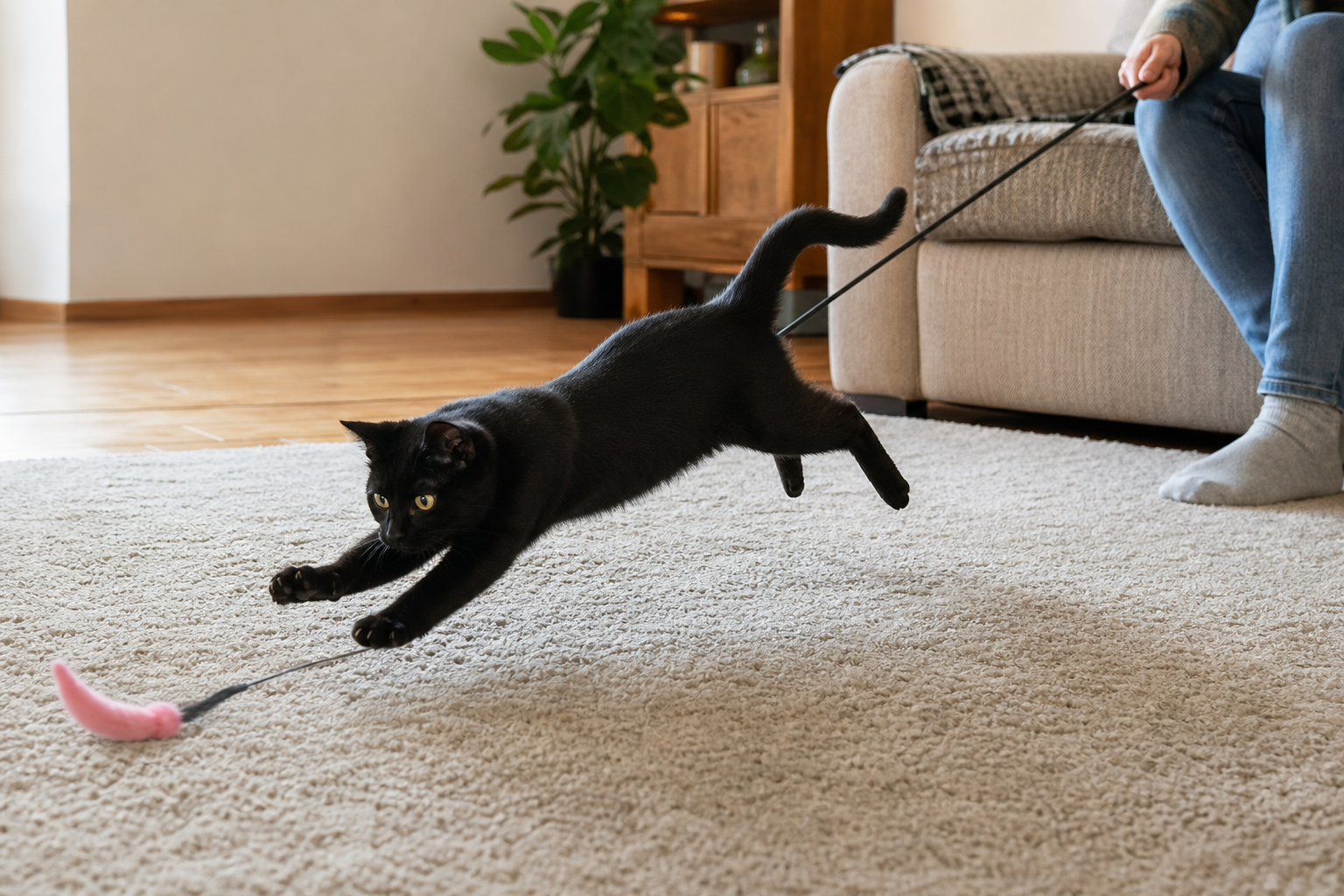
Try several small sessions at moments when your cat already looks alert: after waking, before a usual meal, during a familiar evening burst or when they bring suspicious energy into the room.
Quality matters more than keeping the wand moving until your arm files a complaint. A minute with attention, stalking and a catch may feel more complete than ten minutes of random motion.
There is also no need to turn every session into hard exercise. Kittens, adults, seniors and cats with limited mobility can all have different play styles. A senior cat may prefer slower floor-level movement and shorter reaches. A kitten may require multiple tiny games and a household committee devoted to retrieving toys from beneath furniture.
Read the Cat, Not the Timer

Your cat gets to vote.
Signs of interest may include following the toy with the eyes or head, shifting into a crouch, approaching, chasing, pouncing, batting, carrying or returning after a pause. Some cats become more animated gradually; others arrive at full speed with no visible administrative process.
Signs that the session may be over can include walking away, settling to groom, losing visual interest, hiding without re-engaging, becoming unusually irritable or showing tiredness that is different from their normal short pause.
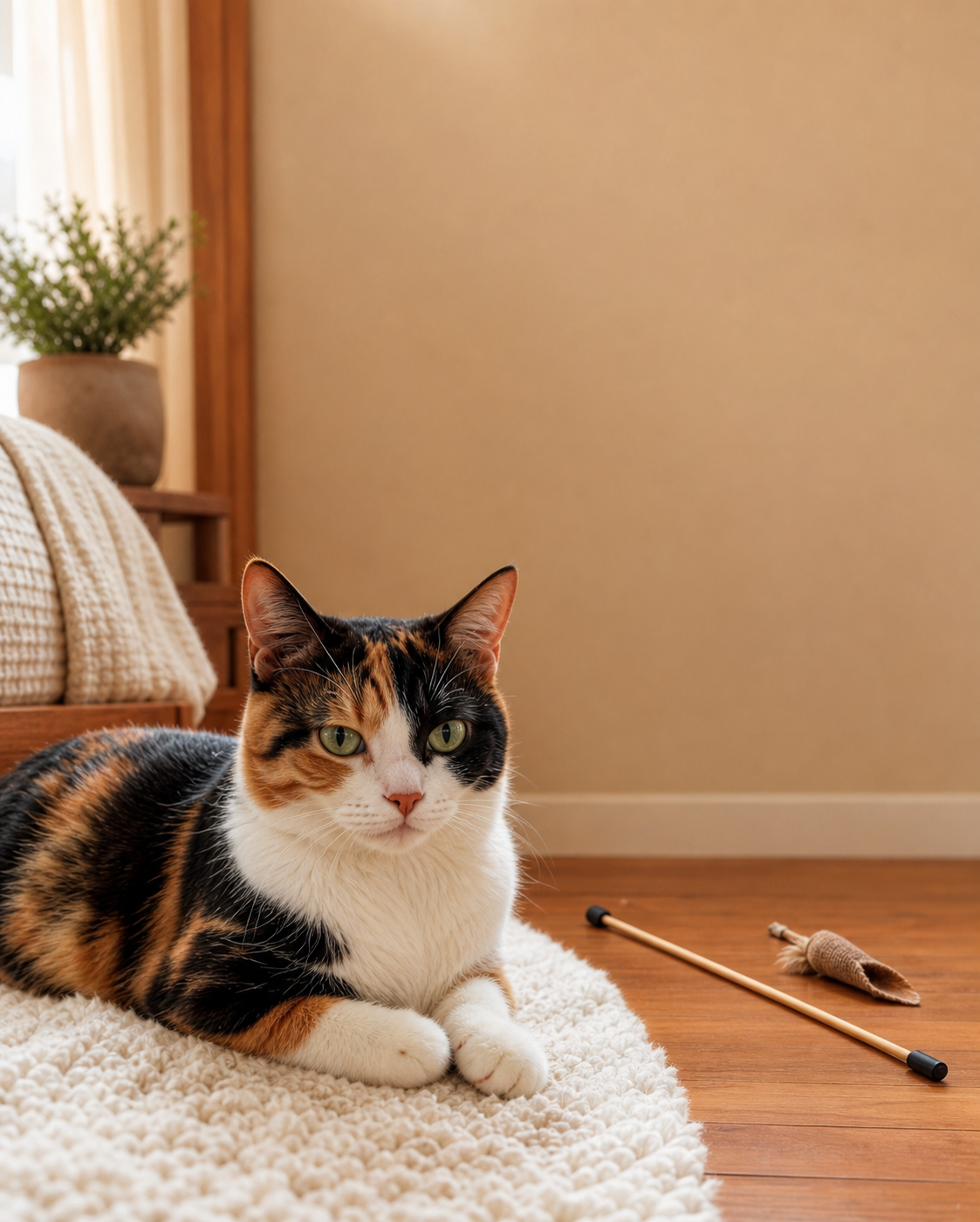
Do not repeatedly place the toy against the cat’s body to restart the game. Do not block their exit. If they stop, let the session stop. Choice is part of good play.
Watch breathing and movement too. Open-mouth breathing, collapse, marked weakness, disorientation or obvious distress are not ordinary “good workout” signs in a cat. End the activity and seek veterinary advice promptly.
The timer is useful for remembering to offer play. It is not allowed to overrule the cat.
Let the Room Join In

You can make play more interesting without filling the home with equipment.
Use ordinary safe features to create a route:
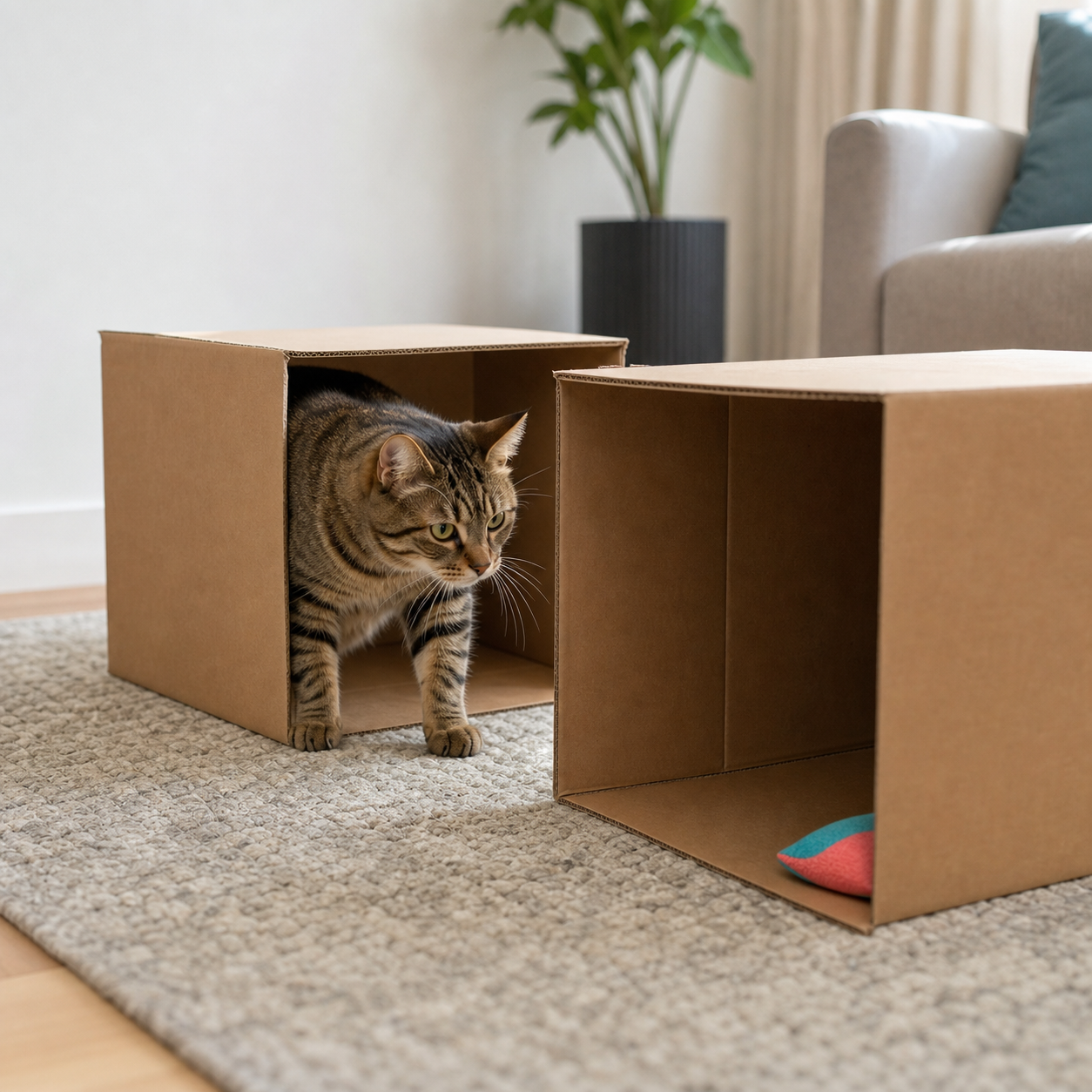
- move the toy around a chair leg rather than across an empty floor;
- let it vanish behind a cardboard box, then reappear;
- drag it along the edge of a rug where the texture changes;
- place a tunnel or open paper bag in the route, with handles removed;
- give the cat a stable low perch or hiding point from which to watch;
- rotate a few toys instead of leaving every toy available all the time.
For cats who enjoy food puzzles, part of the day’s measured food can become a searching game. Keep each cat’s diet and medical needs in mind, especially if weight, allergies or prescription food are involved.
In a multi-cat home, one confident cat may turn every group game into a solo performance. Separate short sessions can give quieter cats a fair chance. Use enough space and avoid creating one narrow route where cats must compete or block each other.
The room does not need to become an adventure park. It only needs a few places where movement can hide, pause and matter.
Hands Are Not Prey

Hands and feet should not be part of the hunt.
It may seem harmless when a kitten attacks wiggling fingers, but the same lesson becomes less charming when the cat is larger and fully committed. Wand toys, balls, soft mice and kicker toys keep teeth and claws at a safer distance from people.
Toy safety matters too:
- supervise wand toys, ribbons, elastic and long strings;
- store them out of reach after play;
- check toys for loose feathers, small pieces, sharp edges and damaged seams;
- remove anything that could be swallowed, tangled around a limb or caught around the neck;
- keep the play route away from unstable furniture, open stairs and breakable objects.
Cornell University’s Feline Health Center specifically warns about small or strand-like pieces that can separate and be swallowed. Cheap can be excellent—a cardboard box or sturdy ball may be a hit—but “homemade” still needs a safety inspection.
If your cat grabs the wand itself, do not tug hard against the mouth. Pause and trade for another toy or a small reward if needed. Tiny hunter, yes. Dental floss demonstration, no.
When Play Changes

A cat’s interest in play can change with age, routine, weather, stress and personal preference. The important clue is often a meaningful change from that cat’s usual pattern.
Speak to your vet if your cat suddenly stops playing, becomes reluctant to jump or turn, seems stiff, hides more, reacts painfully to touch, becomes unusually aggressive, loses appetite, changes grooming or toileting habits, or shows any other health change.
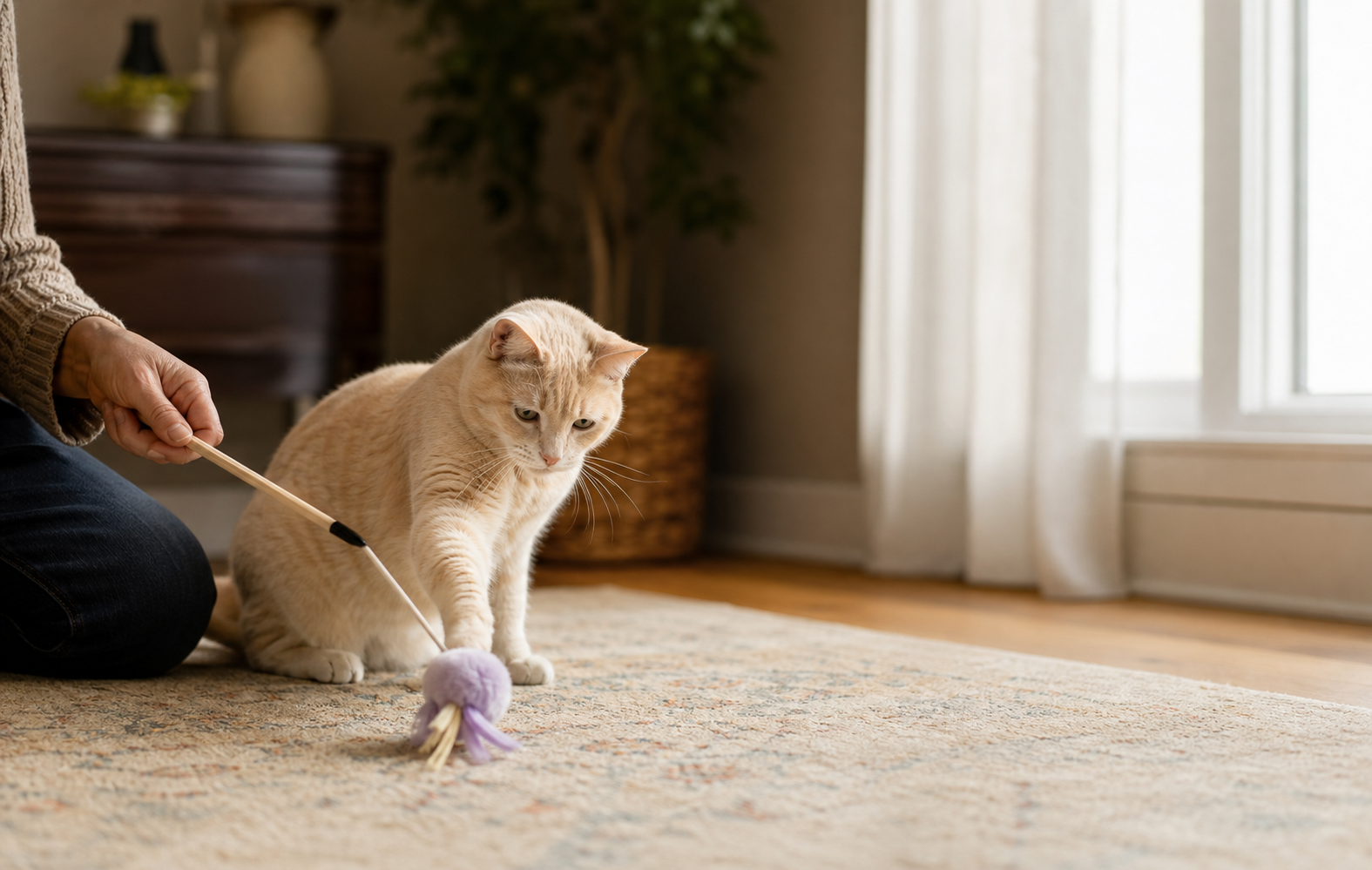
Reduced play is not a diagnosis. Cats can be subtle when they are uncomfortable, and joint pain or illness may first appear as “slowing down.” An older cat still deserves play, but the game may need to stay low, slow and easy to reach. A veterinary team can help you adapt activity when pain, mobility, heart, breathing or other health concerns are involved.
The tiny play-session plan is:
Prey — move away, hide and change direction.
Pause — give the cat time to watch and plan.
Pounce — let the cat choose when to join.
Catch — allow the toy to lose.
Finish — slow down, end clearly and store the toy safely.
That is the session many indoor cats are waiting for: not constant motion, but a small hunt they can actually understand.
Your cat may still sit down halfway through and stare at you as if your performance lacks emotional depth. That is part of the review process.
For more indoor-cat logic, explore why cats knock things off tables, the tiny guide to cat night zoomies and what to do when your cat scratches the sofa. More warm, practical pet guides live in the Aww Articles library.
Sources and Further Reading
- Cat Friendly Homes: Playing With Your Cat
- Cats Protection: Cats and Play
- Cornell Feline Health Center: Safe Toys and Gifts
- Cats Protection: Indoor Cats