

The walk may look slow, but the nose is busy
Some dog walks move at human speed. Forward, forward, quick road crossing, small loop, home. Then the dog reaches one very important lamppost and suddenly the entire schedule is under review.
It can look like dawdling. To the dog, it may be the most information-rich part of the outing.
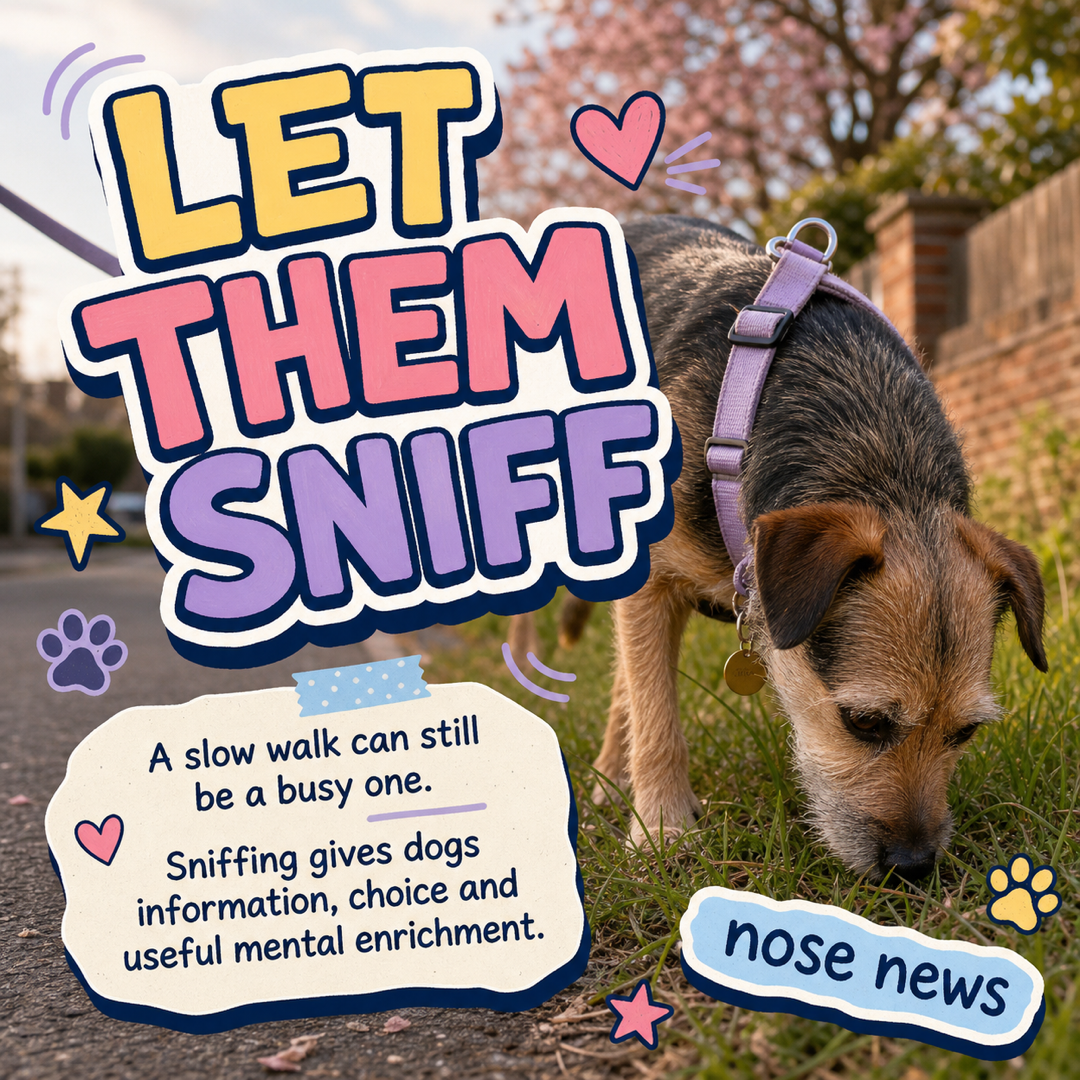
Dogs use scent to investigate who has been nearby, what changed, which direction something travelled, and whether a place feels familiar or new. A slow sniff can be exploration, enrichment, choice, and ordinary dog behaviour all at once.
That does not mean every walk must become forty minutes beside one hedge. It means distance is not the only useful thing a walk can offer.
Sniffing is how dogs read the neighbourhood
Humans tend to notice the route with their eyes. Dogs often meet it nose first.
A patch of grass can hold traces left by people, dogs, wildlife, food, rain, plants, and yesterday’s weather. We may see the same corner we passed in the morning. The dog may find a completely updated edition.
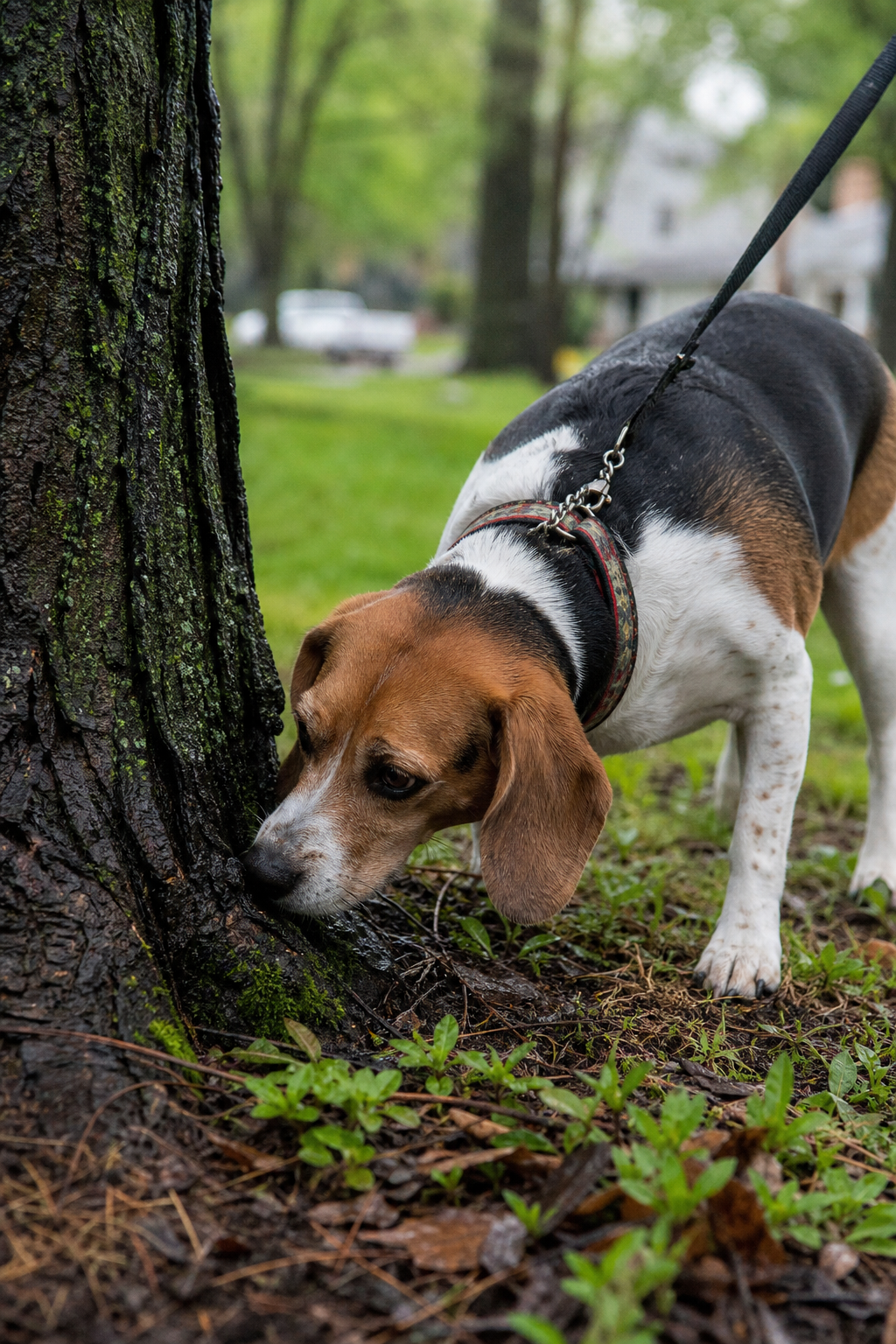
That is why sniffing is more than a delay between steps. Dogs Trust describes sniffing as a natural behaviour and a key way dogs gather information about their environment. VCA also treats sniff walks as mental enrichment that helps dogs process the world around them.
The CloudyAww version: the dog is not stuck. The dog is reading very small local news.
A slow walk can still be a full walk
It is easy to judge a walk by distance, pace, or the number on a fitness app. Dogs do not necessarily use the same scoring system.
A sniff-focused outing can cover less ground while asking the dog to process more information. Searching, choosing where to investigate, following a scent trail, and checking a changing environment all engage the brain.
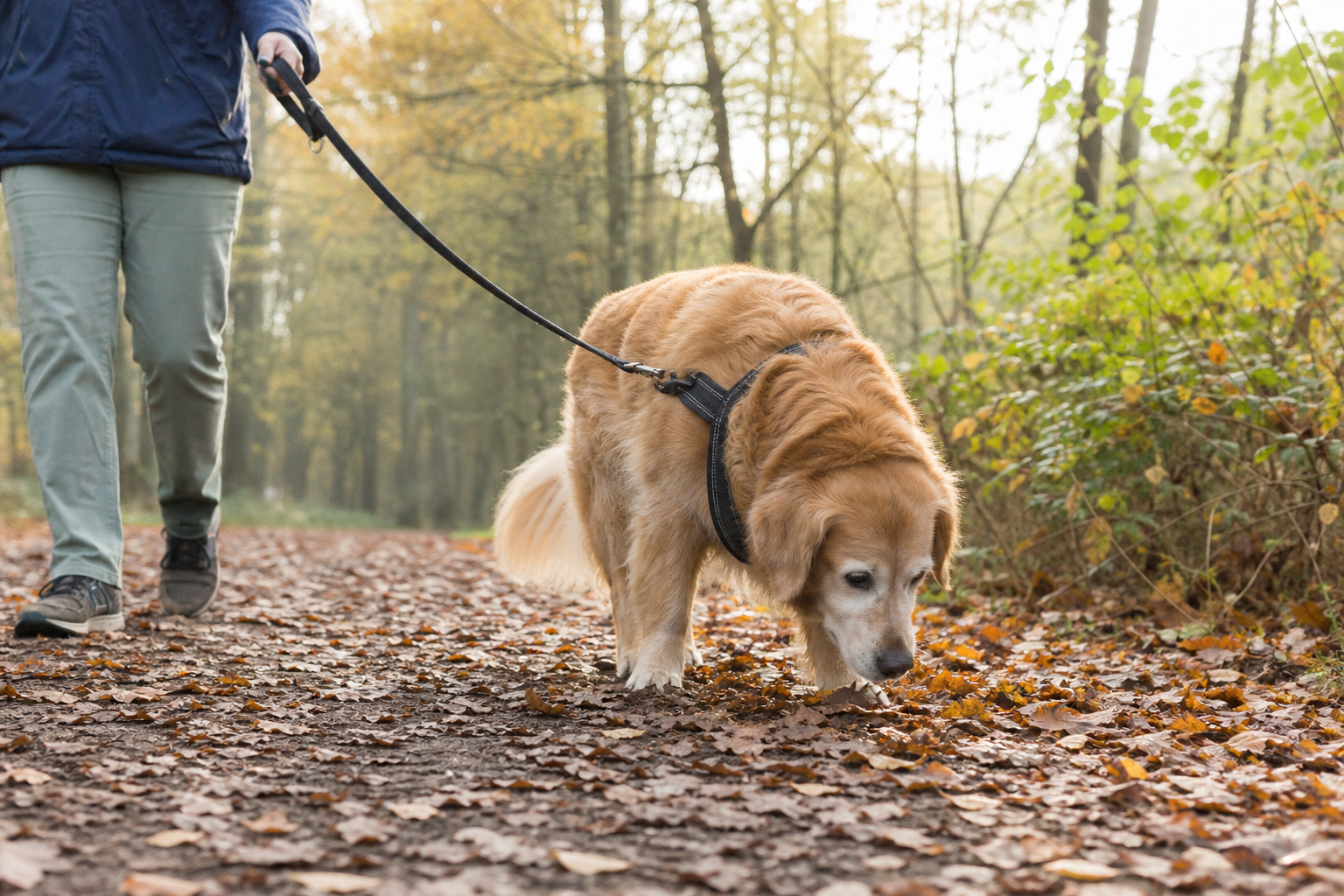
That can make a quieter, shorter route genuinely satisfying, especially for dogs who are older, recovering, easily overwhelmed, restricted to a lead, or living in busy urban areas. It can also be a useful change for dogs whose normal walks feel like the same hurried loop every day.
Sniffing is not a magic replacement for suitable physical activity. Dogs still need movement appropriate to their age, health, body, breed tendencies, and individual preferences. The useful idea is balance: some walking for the body, some nose-led exploring for the brain, and enough flexibility to notice what your dog actually enjoys.
Give choice without handing over the traffic plan
Choice can make an outing richer. Safety still belongs to the human.
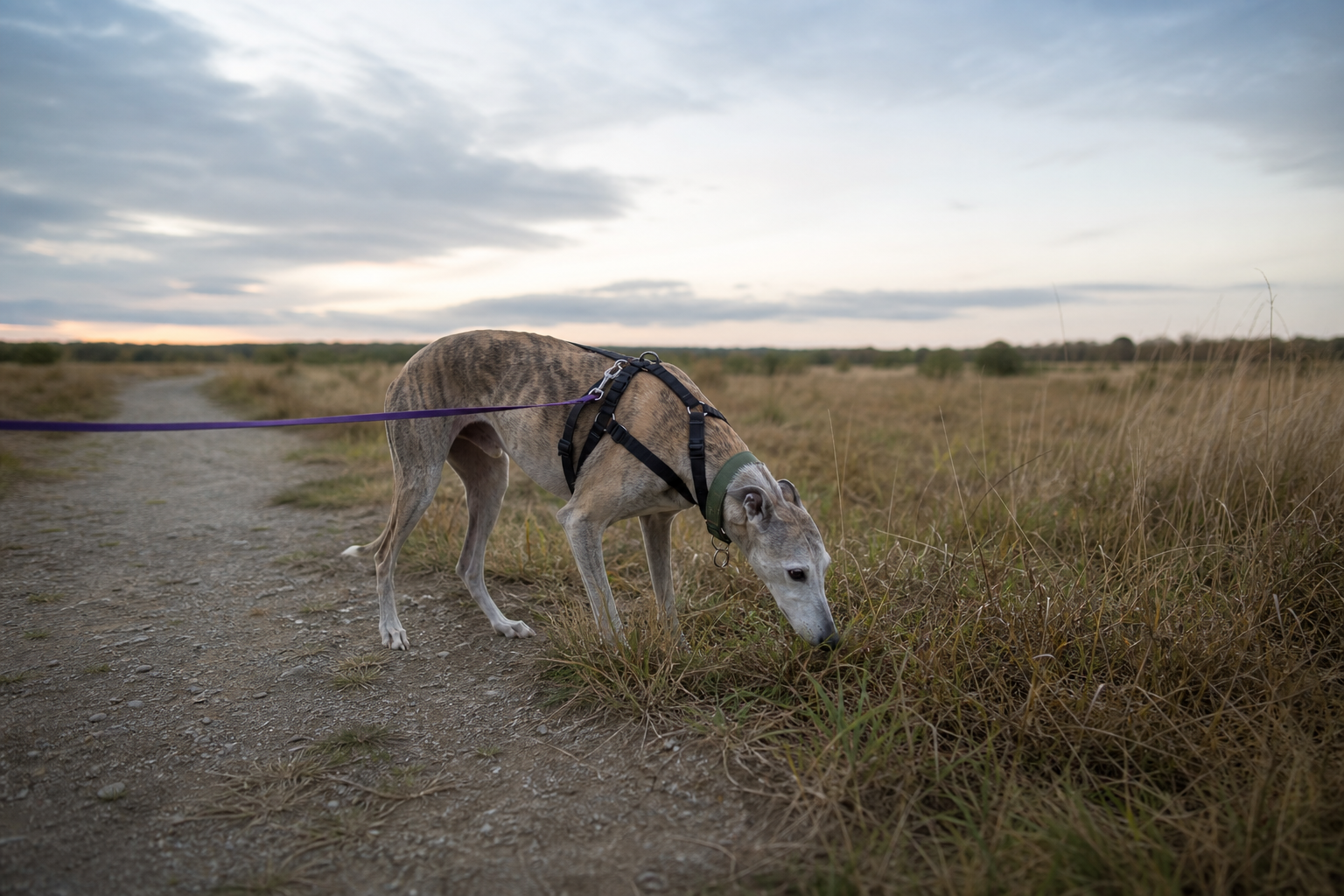
In a quiet, suitable place, you can let your dog choose which side of the path to investigate, whether to pause at a tree, or when to move on from an ordinary safe smell. Keep control near roads, bicycles, livestock, wildlife, dropped food, rubbish, unfamiliar dogs, and anything your dog should not approach.
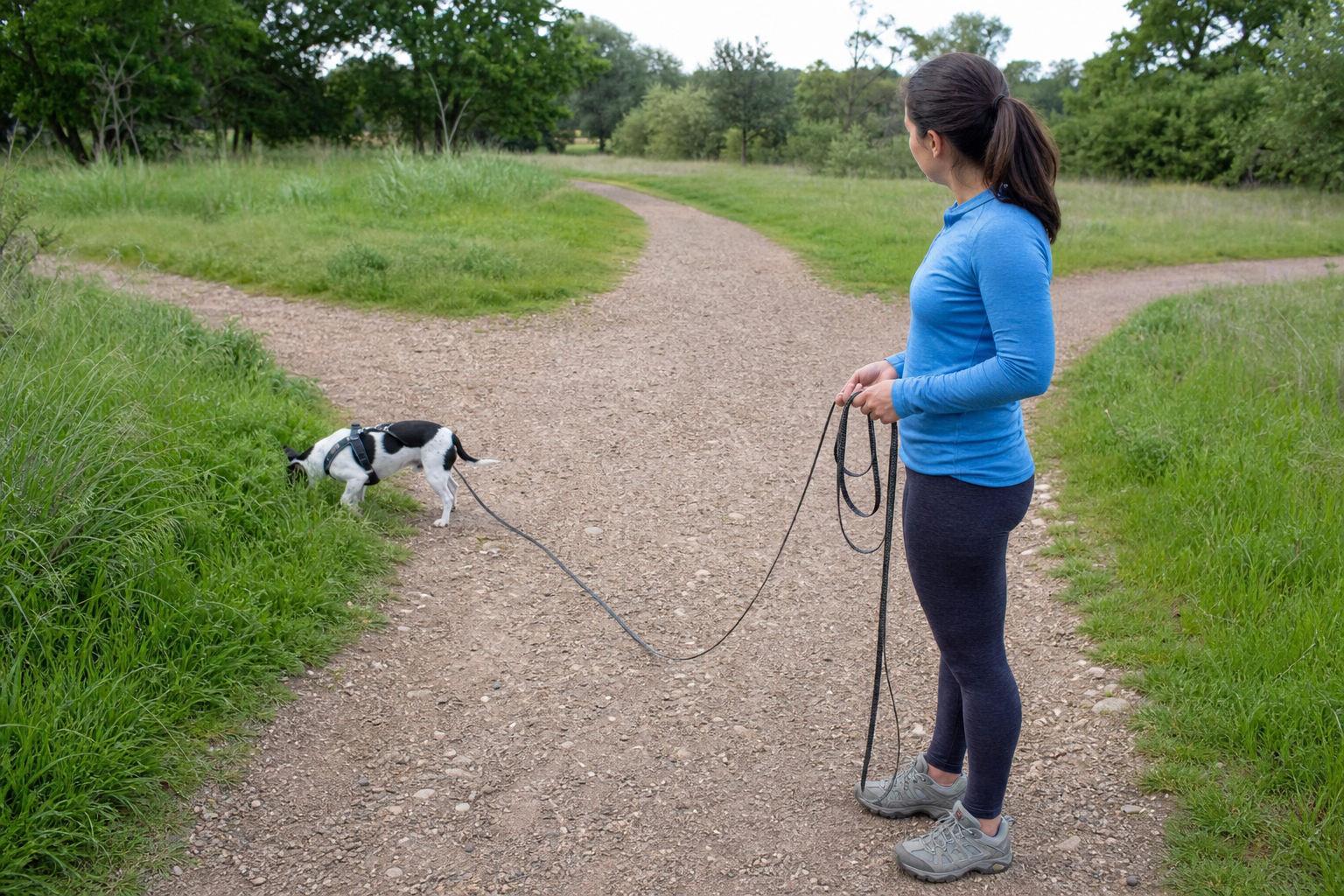
A comfortable harness and an appropriate lead can give a dog room to explore without turning the walk into an uncontrolled expedition. Long lines can be useful in suitable open spaces, but they need careful handling and are not right beside traffic, crowds, or places where they can wrap around people, dogs, trees, or street furniture.
Freedom should feel calm and manageable. If the lead is tight, the environment is overwhelming, or the dog is dragging toward something unsafe, add distance and simplify the setup.
Build a walk with more than one gear
A good walk does not need to choose between military heelwork and complete botanical investigation.
Try giving the outing different gears. Start with a calm toilet and sniff section. Add a comfortable stretch of loose walking. Pause somewhere safe for a longer investigation. Practise one or two easy check-ins. Finish with another calm sniff before going home.
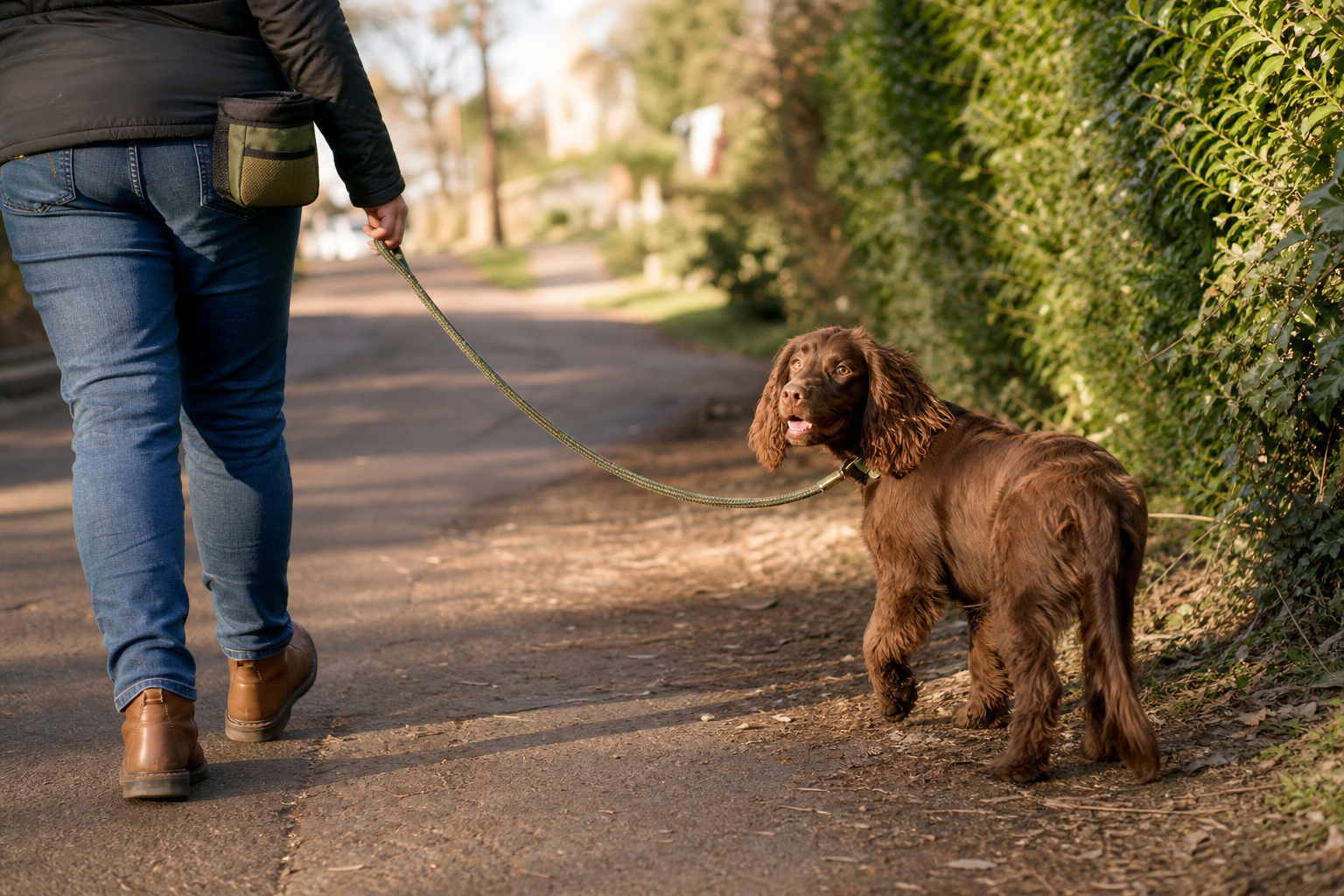
A simple cue such as “go sniff” can tell the dog when exploration is available. A cheerful “this way” can help you leave a smell and move on without turning every lamppost into a negotiation. Rewarding the transition is usually kinder and clearer than repeatedly pulling the dog away.
The walk should not become a constant training exam either. A dog does not need to perform for every metre of fresh air. Leave room for ordinary dog time.
Different dogs need different versions
Some dogs investigate every blade of grass. Some want two quick checks and then prefer to move. Some relax in a quiet woodland path but cannot think clearly on a noisy pavement. Others gain confidence from familiar routes and find constant novelty tiring.
Age, health, past experience, breed tendencies, confidence, and the environment can all shape the walk. A young energetic dog may enjoy sniffing alongside more active exercise. A senior dog may value a slower route with comfortable surfaces and plenty of time. A worried dog may need distance and predictability before curiosity appears.
Watch the whole dog. Loose movement, a soft face, normal breathing, easy recovery, and the ability to disengage usually look different from frantic scanning, a rigid body, tucked posture, repeated freezing, or a dog who cannot respond at all.
Sniffing can be calming and rewarding, but not every nose-down moment means relaxation. Context still matters.
Keep the sniffing adventure safe
The nose may vote yes to things the stomach, paws, or veterinary bill would strongly reject.
Do not let dogs investigate unknown chemicals, toxic plants, sharp rubbish, spoiled food, animal remains, pesticides, road salt, or anything that may be dangerous. Be cautious around stagnant water and areas contaminated with waste. Respect wildlife, nesting areas, livestock, private land, and other dogs who need space.
If your dog eats first and asks questions later, practise a reward-based “leave it” and carry something better to trade. Avoid punishment around found objects; it can make some dogs swallow faster or guard what they found. A qualified reward-based trainer can help if scavenging or guarding makes walks difficult or unsafe.
The goal is not to remove exploration. It is to create safe boundaries around it.
When a slower walk is not just a sniff walk
A dog choosing to inspect a hedge is different from a dog who suddenly cannot or does not want to move.
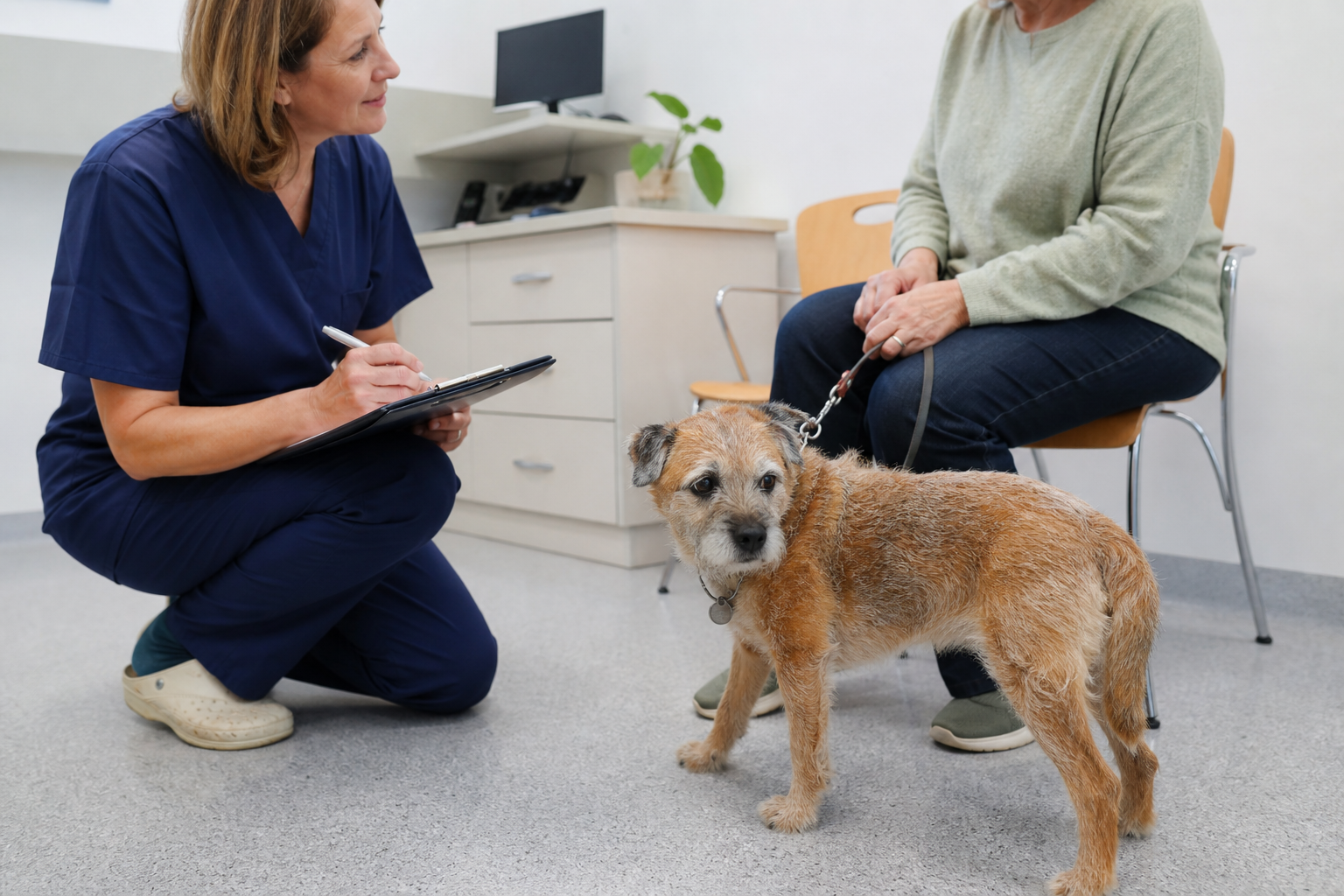
Contact a vet if your dog becomes unusually slow, repeatedly stops or lies down, limps, looks stiff, struggles to rise, pants heavily without a clear reason, refuses familiar walks, seems weak, reacts painfully to touch, or shows a sudden change in stamina or behaviour.
VCA and Blue Cross both note that reluctance to walk, slower movement, stopping, stiffness, and reduced interest in usual activities can be signs of pain. Those clues should not be dismissed as stubbornness or an extra-interesting smell.
Weather matters too. Heat, cold, ice, rough ground, and hot pavement can change what a safe walk looks like. Adjust the route and duration to the dog in front of you, not the plan you made before leaving the house.
The tiny sniff-walk plan
Choose a safe route and leave enough time that every pause does not feel inconvenient. Let your dog investigate ordinary safe smells. Mix sniffing with comfortable movement. Use simple cues for exploring and moving on. Keep the lead setup appropriate to the environment. Watch body language, and treat sudden changes as information.
A better walk is not always longer or faster.
Sometimes it is simply a walk where the dog gets to be a dog for a while: nose down, brain busy, collecting tiny neighbourhood updates while the human waits beside a shrub and pretends this was always the plan.
More tiny pet logic lives across CloudyAww, where the funniest animal moments usually have a small real reason hiding underneath them.
Keep following the behaviour trail with Tiny Guide to Dog Body Language: Tail, Ears and Tiny Pauses, Why Small Dogs Bark at Big Dogs, and How to Help a Dog Who Slips on Smooth Floors. More warm, practical pet explainers live in Aww Articles.
Sources and Further Reading
- Dogs Trust: Enrichment activities for dogs
- Blue Cross: Enrichment for dogs
- VCA Animal Hospitals: Sniffing walks for dogs
- VCA Animal Hospitals: Enrichment, predictability and scheduling
- AKC: Dog training games for walks
- VCA Animal Hospitals: Signs of pain in dogs
- Blue Cross: How to spot if your dog is in pain