

A cat can walk into a room carrying a question mark, a flagpole or a feather duster behind them.

The tail is wonderfully visible, so it is tempting to treat it like a mood label: up means happy, swishing means cross, puffed means scared. Real cats are less interested in our tidy filing system. The same movement can appear in more than one situation, and the useful message comes from the tail, the rest of the body and what happened a second ago.
That does not make the tail useless. It makes it part of a sentence.
Read it gently, add the ears, eyes, whiskers and posture, then give the cat room to finish the thought.
A Tail Is Not a Subtitle
Cats Protection describes feline body language as subtle and recommends reading small changes across the whole cat. An upright tail can belong to a relaxed greeting, but a tail alone cannot confirm how safe, playful or sociable a cat feels in that exact moment.
Start with context. Did your cat just wake up, spot another cat, hear the cupboard that contains snacks or reach the fourth stroke of a petting session? Then look beyond the tail. Relaxed eyes, forward or softly rounded ears, loose muscles and an easy approach tell a different story from wide pupils, flattened ears, a crouch or a body angled towards an escape route.
This whole-cat habit also prevents a common mistake: assuming a cat has acted “out of nowhere.” Their first request for space may have been a faster tail tip, a pause, a look away or an ear turning sideways. The dramatic part is often the final sentence, not the opening line.
CloudyAww’s guide to slow blinking uses the same rule. One familiar signal becomes more useful when the rest of the cat looks comfortable too.
Upright, Loose and Softly Curved
An upright tail on a cat who is approaching with a loose body commonly appears in friendly, confident greeting contexts. The tip may be straight, gently curved or shaped like a small question mark. If the eyes, ears and walk are relaxed, you can offer a hand at cat-nose height and let the cat choose whether to close the distance.
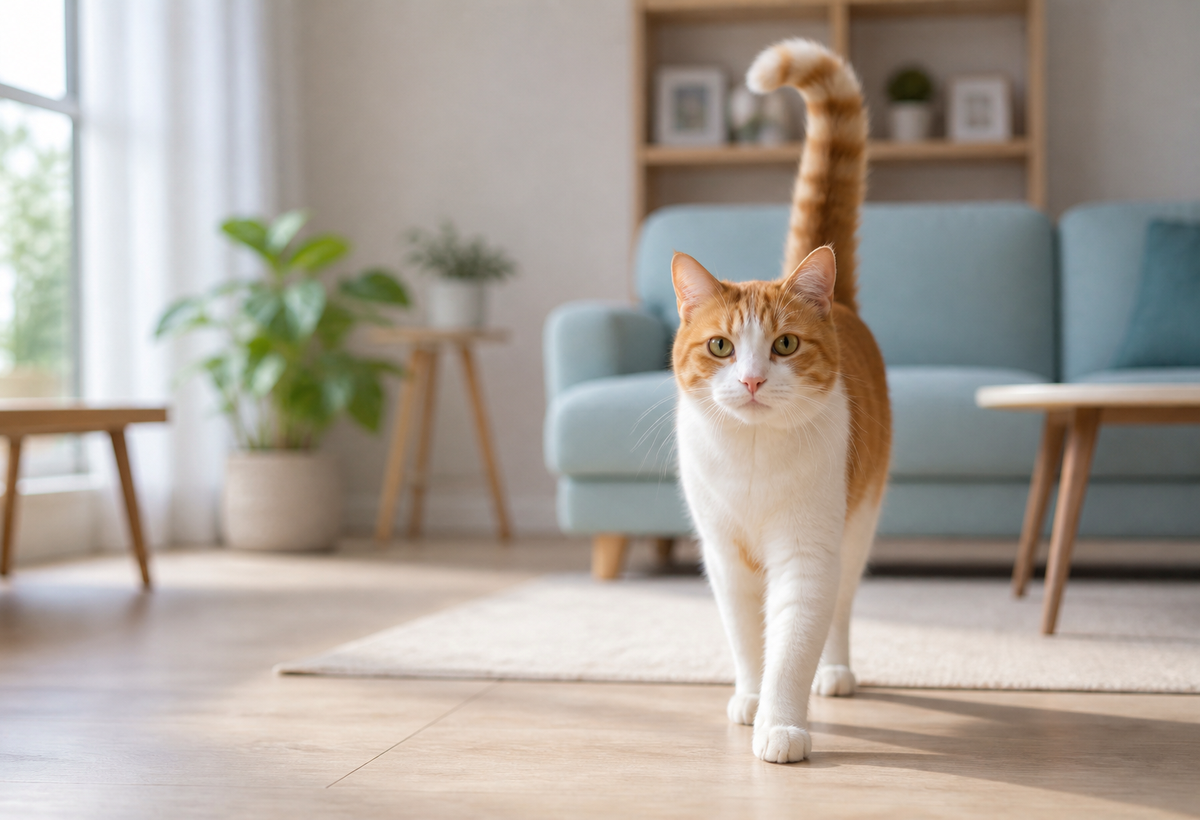
Some cats quiver an upright tail when they are excited to see a familiar person. Context matters here as well: a greeting quiver while the cat rubs against you is different from a cat backing towards a vertical surface and urine marking. The movement may look similar for one second, but the body position and behaviour around it change the read.
Do not turn a friendly tail into compulsory cuddling. A cat can say hello without ordering the full human-contact package. Offer, pause and watch what happens next. Consent is allowed to be tiny and temporary.
Low, Tucked or Wrapped Close
A low or tucked tail can appear when a cat feels uncertain, anxious or frightened. VCA also notes that pain can sometimes sit inside this picture, especially when the posture is unusual for that cat or appears with other changes.
A tail wrapped around the body is not automatically a warning. Cats also wrap themselves neatly while resting because apparently one body can be both animal and scarf. The question is whether the cat looks loose and settled or tense, guarded and ready to leave.
Give a worried cat a clear route away. Do not pull them from a hiding place or reach into a corner to prove that the thing is safe. Lower the pressure, make the environment quieter and allow observation from a distance. If the posture is new, persistent or paired with reduced appetite, hiding, lameness or another health change, call your vet.
Flick, Swish, Thump: Speed Changes the Message
A moving cat tail is not the canine happiness meter copied across species. Cats Protection warns that faster, more erratic tail movement can accompany agitation or high arousal. VCA similarly describes swishing, thumping or thrashing as a common sign that a cat may be irritated or finished with an interaction.
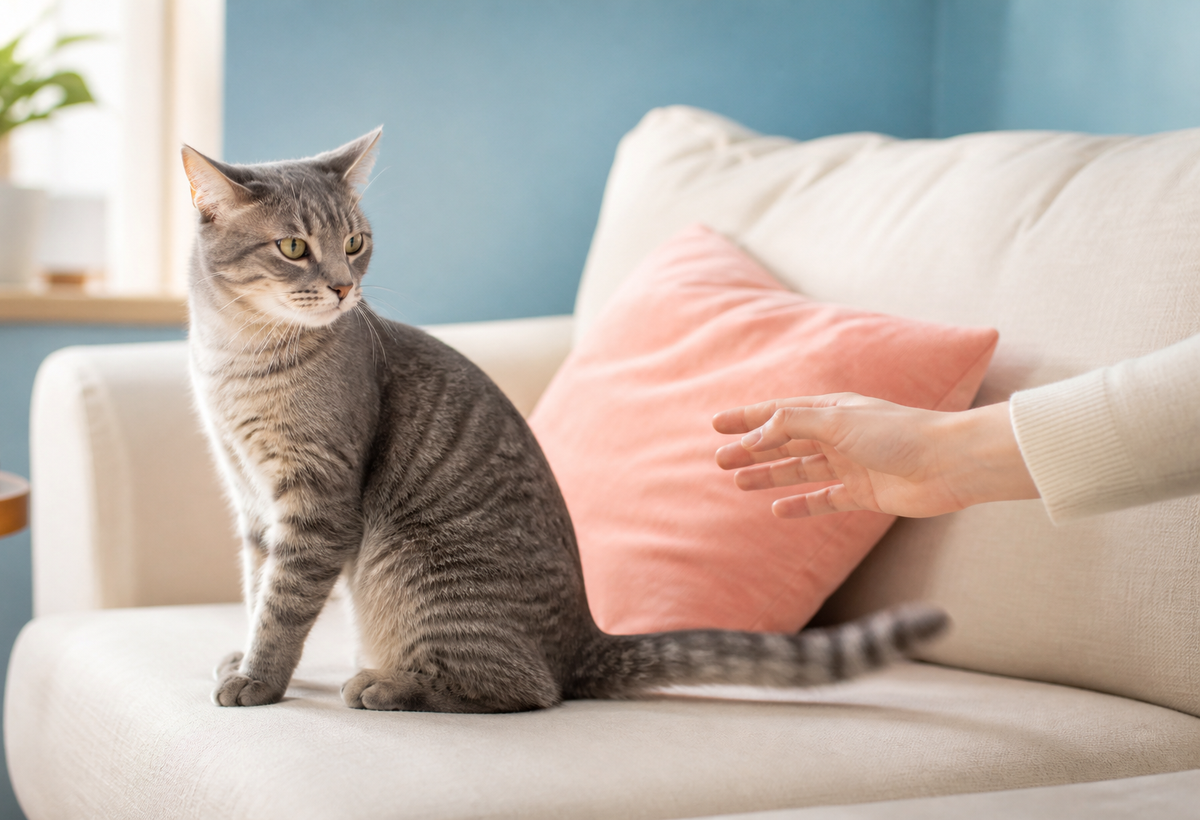
Watch the pace and the moment. A small twitch at the tip while a cat studies a toy or bird can sit inside focused hunting behaviour. A broad, accelerating sweep during stroking can be an early request to stop. A slow side-to-side movement while a cat paces may reflect indecision. None of these is a promise, but each is a useful reason to pause.
The best response is wonderfully undramatic: stop your hand, soften your body, and let the cat choose the next move. If the tail settles and the cat leans back in, you have new information. If they leave, the conversation worked.
The same pause is useful during play. When a cat walks away mid-game, the answer is usually not to chase them with the toy like a tiny sales representative who refuses to accept the meeting is over.
When the Fur Joins In
A puffed tail makes a cat look larger. It commonly appears during high arousal, including fear, surprise or a defensive response. Read the back, legs, ears, pupils and direction of travel too. A sideways arched cat with flattened ears is giving a very different message from a playful youngster who briefly puffs during an enthusiastic sideways hop.
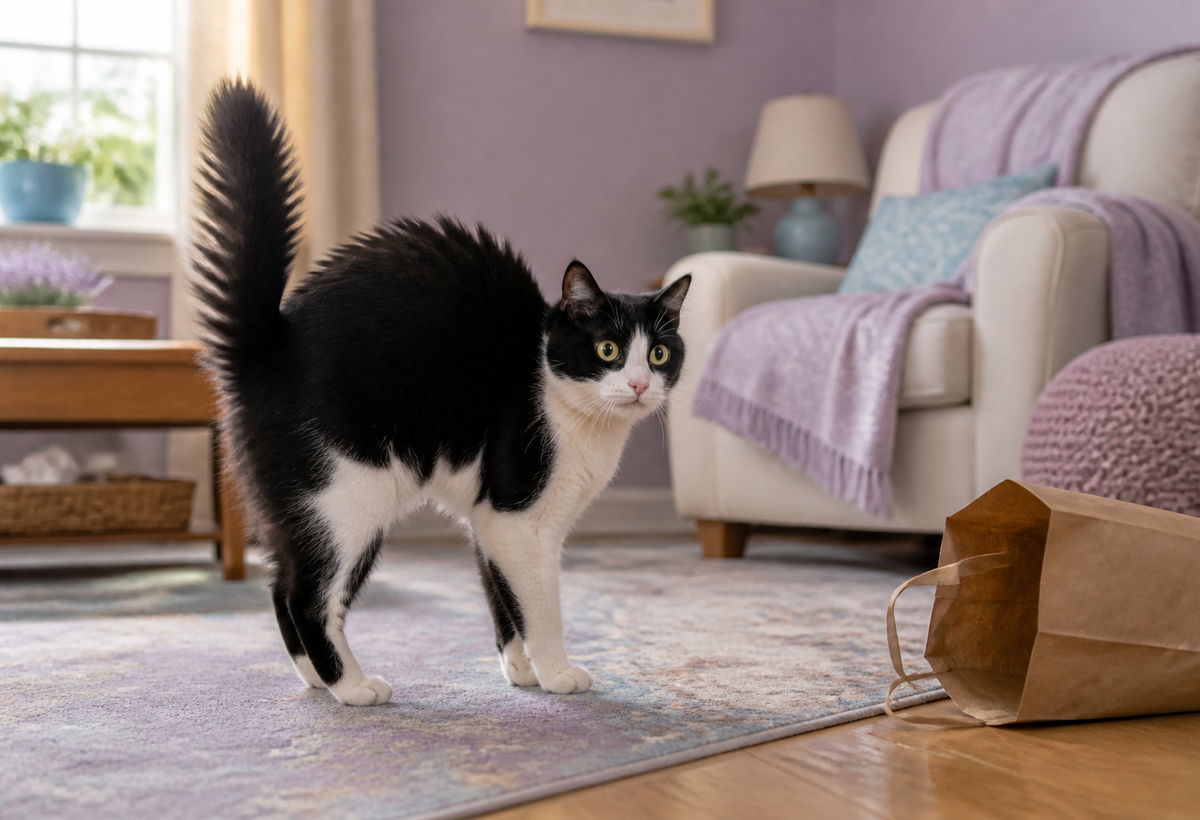
Create distance rather than testing the cat. Remove the trigger when it is safe to do so, or give the cat a way to move away from it. Do not pick up a frightened cat unless immediate safety requires it; close contact can make a trapped animal feel they have fewer options.
If another cat is involved, avoid putting your hands between them. Cats Protection recommends interrupting conflict without grabbing the cats, then allowing time and space to settle. CloudyAww’s article on cats hissing at reflections is a useful reminder that the cat is responding to what the scene appears to mean, not being ridiculous for our entertainment.
A Tiny Sideways Case Study
CloudyAww’s Cats Activated Sideways Mode. shows why the whole-body rule matters. The sideways shape is funny at once, but the useful read comes from the tail, back, ears, movement and what the cat does next.
A brief sideways hop during energetic play can look very different from a cat who stays stiff, flattened and focused on escape. The clip is a useful reminder to watch the movement unfold rather than freezing one dramatic frame and declaring the case closed.
Let the cat create distance if they want it. If the body loosens and ordinary play resumes, that recovery is part of the evidence too.
The Three-Question Pause
When a tail catches your eye, try three questions before choosing a response:
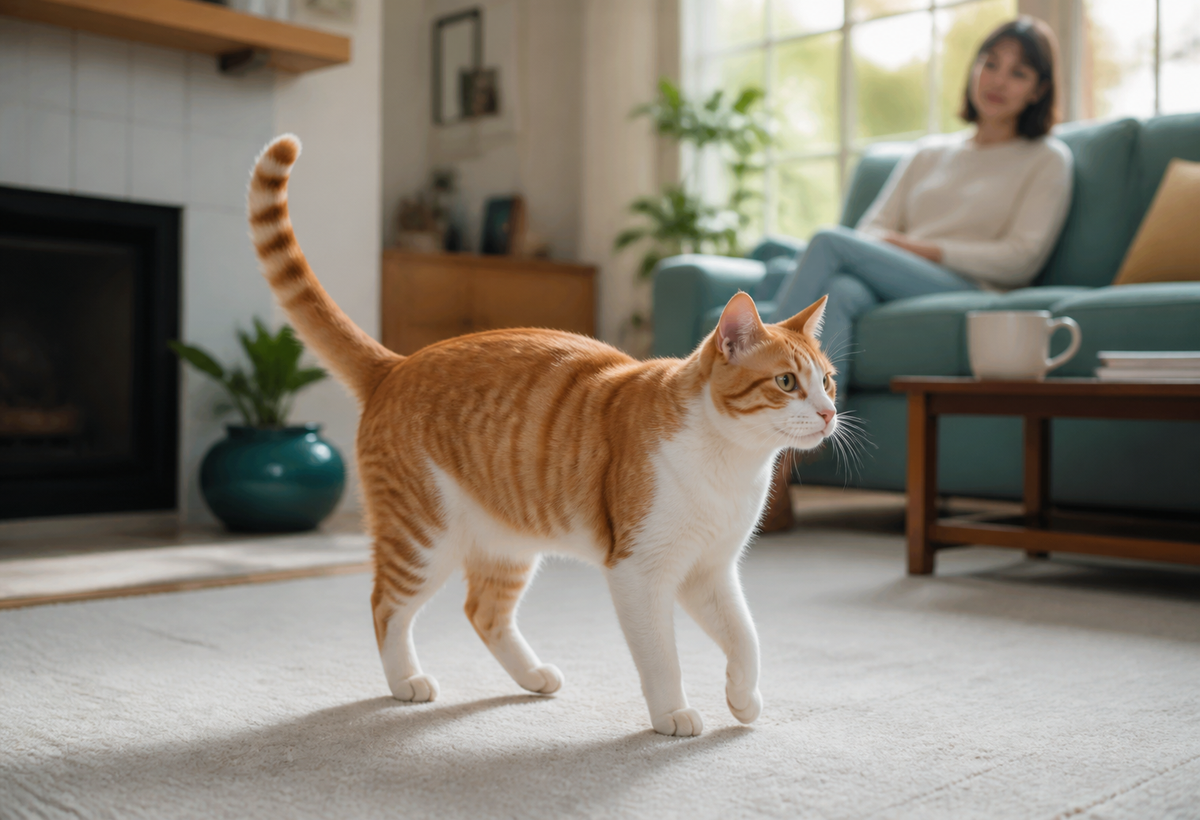
- What is the tail doing? Note height, shape, speed, tension and whether the fur is raised.
- What is the rest of the cat doing? Add ears, eyes, whiskers, weight distribution, voice and escape behaviour.
- What just happened? Include touch, sound, another animal, a toy, food, waking or a change in the room.
Then choose the smallest helpful response. A relaxed approach may invite a gentle greeting. A quickening tail during touch asks for a pause. A low, guarded cat needs space and an escape route. A sudden physical change needs a health check, not a personality theory.
The method is deliberately cautious. It replaces “I know exactly what you feel” with “I noticed this; what else can I see?” Cats tend to do better when human certainty is not standing in the doorway.
When the Tail Becomes a Health Question
Behavioural context does not explain a tail that suddenly hangs limp, looks injured, bleeds, swells or appears painful. Cats Protection notes that tail-pull injuries can affect nerves at the base of the tail and may be associated with difficulty passing urine or faeces. A limp tail needs veterinary assessment even when the cat is trying hard to look fine.
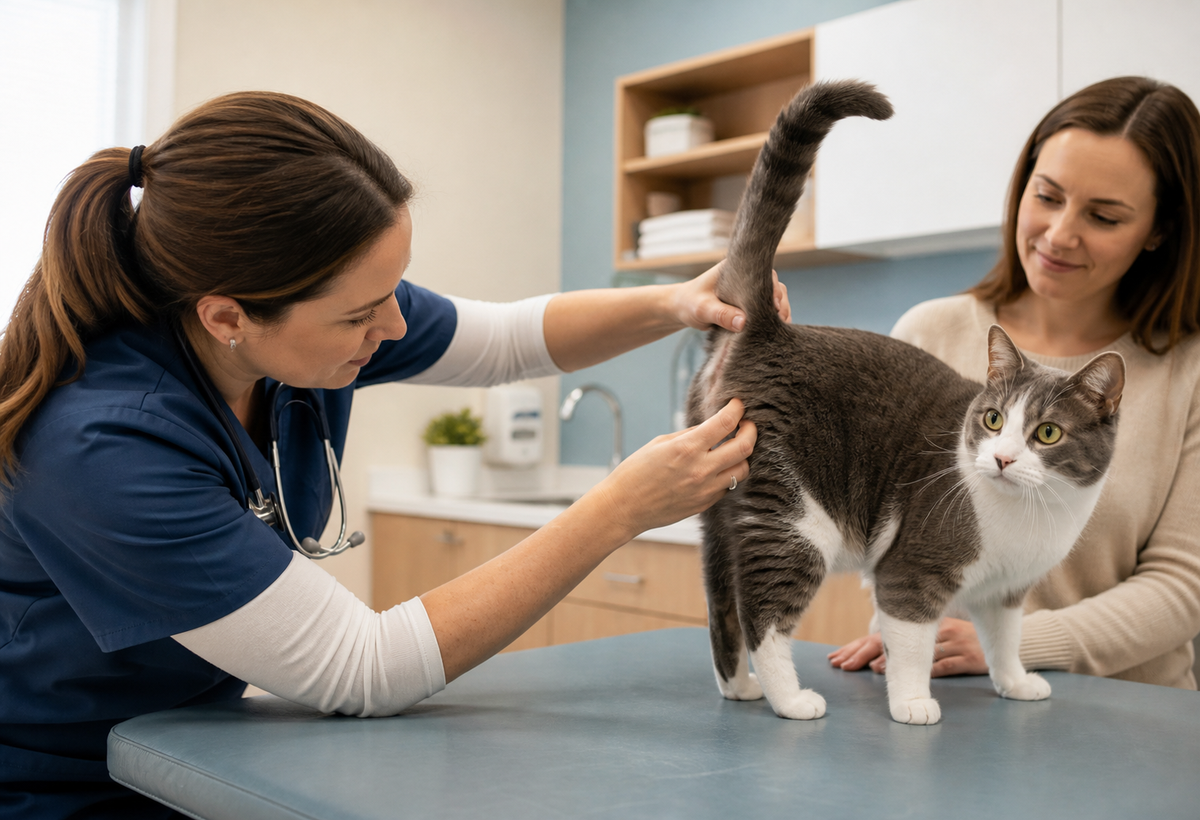
Repeated tail biting or chewing also deserves attention. Itching, wounds, pain and other medical problems can be involved. Do not bandage, pull or manipulate a painful tail unless a veterinary professional tells you exactly what to do.
Call a vet urgently if tail change follows an accident or comes with weakness, balance problems, difficulty toileting, severe pain or breathing trouble. Cats are good at compressing a health complaint into very small visible clues. The tail may be one of them.
The CloudyAww Read
A cat’s tail is expressive, but it is not a translation app with six fixed buttons.
An upright, loose tail often fits a friendly approach. A fast swish can ask for a pause. A tucked or puffed tail can signal that the cat needs more space. The useful read comes from combining that shape with the whole body, the setting and the cat you know.
Notice early, respond softly and let the cat revise the message. That is not uncertainty failing. That is communication working.
Browse more warm, practical pet logic in the Aww Articles library.
Sources and Further Reading
- Cats Protection: Cat body language
- Cats Protection Behaviour Guide 2025
- Cats Protection: Feline body-language visual guide
- VCA: How does your young cat communicate with their tail?
- Cats Protection: Cat first aid and tail injuries